Thermal Anemometer:Measurement Application in Heating and Ventilation Systems
With the improvement of living standards, heating and air conditioning systems have been widely adopted in various locations. The installation quality of these systems directly affects human health. Airflow variations at air conditioning outlets, HVAC exhaust vents, and air intakes are closely related to personal comfort. To evaluate airflow changes, installation technicians commonly use anemometers to measure air velocity, flow rate and temperature. Among various types, thermal anemometers are the most widely used.
Thermal anemometers are divided into constant-current and constant-temperature models. Constant-temperature anemometers feature low thermal hysteresis, wide frequency response and rapid reaction, while constant-current types lack these advantages.Major applications include measuring the velocity and direction of average flow, analyzing fluctuating flow velocity and its frequency spectrum, detecting Reynolds stress and velocity correlation in turbulent flow, assessing wall shear stress, and measuring fluid temperature. It ranks among the most sensitive and responsive anemometers.
Supply air temperature in heating systems greatly affects indoor comfort. Determining the proper extraction airflow and wind speed to maintain fresh indoor air can be accurately achieved with thermal anemometers. This stable and reliable professional instrument measures wind speed, air volume and air temperature with high precision and low error. Its portable design allows convenient on‑site measurement at different work locations.
Equipped with a USB interface, it supports maximum, minimum, average value display and data hold functions. Measured data can be transmitted to a computer for comprehensive analysis. The measuring range covers 0.2–20 m/s with an extendable thermal probe, enabling easy detection in narrow spaces. For duct airflow testing, air volume can be calculated automatically after entering the duct cross‑sectional area.
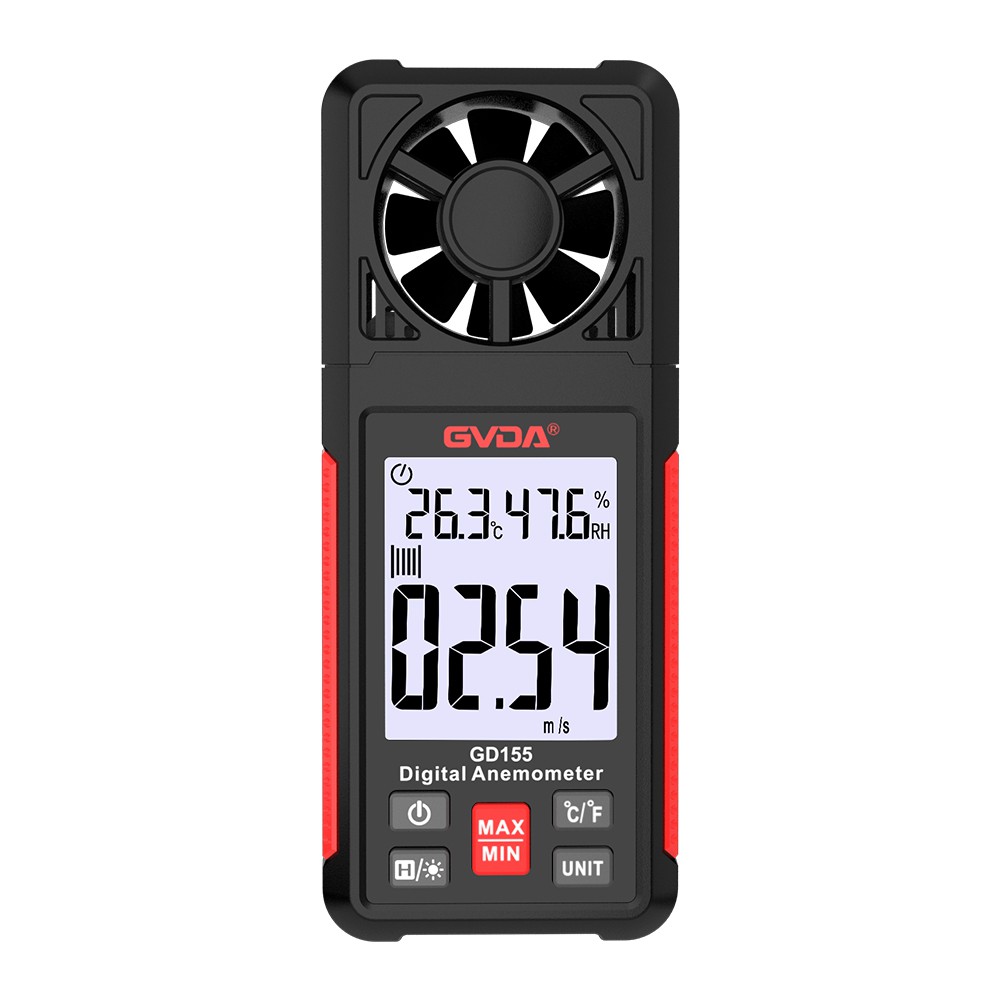
Fitted with a large backlit LCD screen, the instrument ensures clear readings even in dark environments. Thermal anemometers are widely applied in indoor air quality monitoring, industrial environmental engineering, duct condition testing, and HVAC equipment performance commissioning.