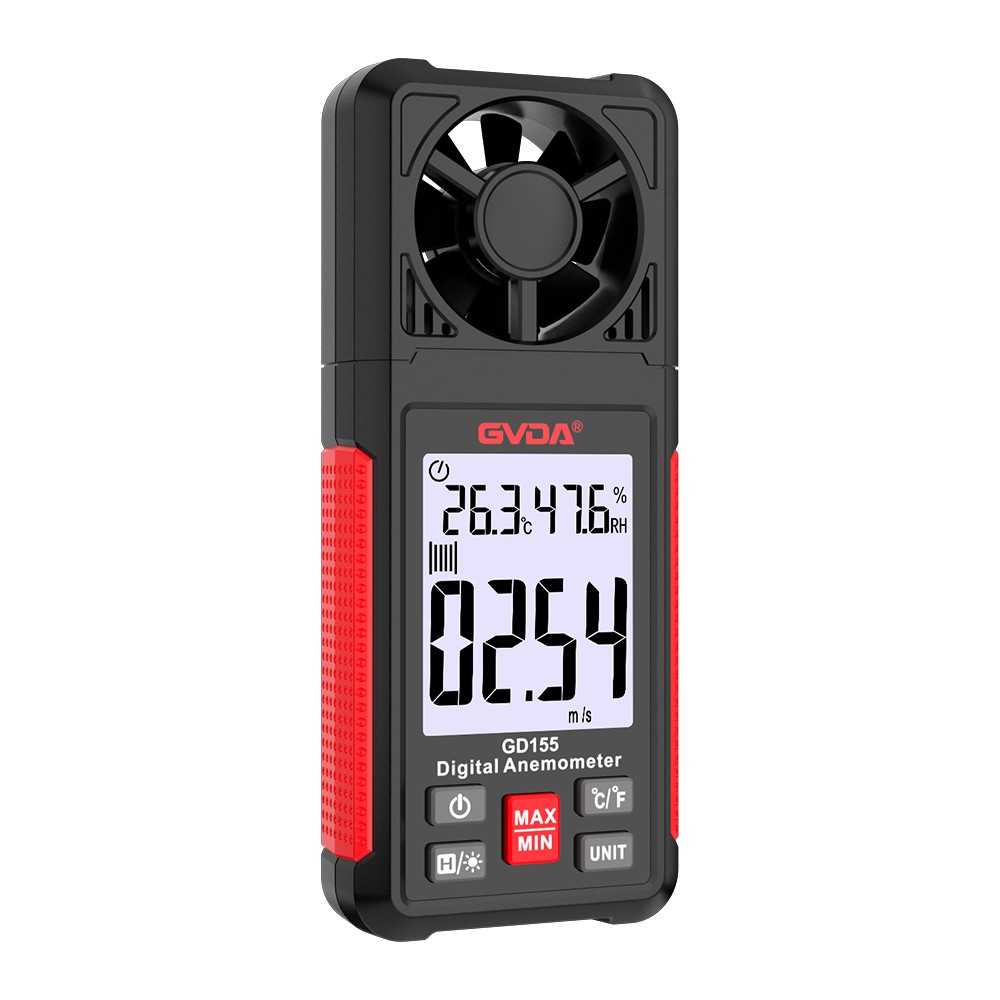
Structural Composition of Anemometer Parts
Anemometers operate on the principle that cold flowing air removes heat from heating elements. A control switch maintains a constant temperature, making the regulated current proportional to the flow velocity. When thermal probes are used in turbulent flow, airflow striking the heating element from all directions simultaneously reduces measurement accuracy. In turbulent conditions, readings from thermal flow sensors are generally higher than those from rotary vane probes. This phenomenon is frequently observed during duct measurements and may occur even at low flow rates, depending on the duct's turbulence design.
Therefore, all anemometer measurements should be taken on straight duct sections. The start of the straight section must be at least 10×D upstream of the measuring point, and the end at least 4×D downstream, where D stands for the duct diameter in centimeters. No obstructions are permitted within the flow cross-section.
Rotary Vane Probe of the Anemometer
The rotary vane probe works by converting mechanical rotation into electrical signals. A proximity sensor counts the rotations of the impeller and generates a pulse train, which is processed by the measuring unit to determine the rotational speed.
Large‑diameter probes (60 mm, 100 mm) are suitable for measuring turbulent flow at medium and low velocities, such as at duct outlets. Small‑diameter probes are better suited for airflow measurement where the duct cross‑sectional area is more than 100 times that of the probe.
Positioning of the Anemometer in Airflow
For correct operation of a rotary vane probe, the airflow direction must be parallel to the impeller axis. Slight rotation of the probe within the airflow will change the measured value. The probe is properly aligned when the reading reaches its maximum. For in‑duct testing, a sufficiently long straight duct segment upstream of the measuring point minimizes the impact of turbulence on thermal probes and pitot tubes.
Practical Duct Air Velocity Measurement
Field experience shows that the 16 mm anemometer probe offers the widest range of applications. Its dimensions ensure good air permeability while withstanding flow velocities up to 60 m/s. As a reliable measurement technique, in‑duct airflow testing together with indirect measurement procedures such as the grid traversal method is widely applicable to air velocity detection.