Learn how to select anemometer probes
Thermal Probe of AnemometerThe working principle of a thermal anemometer probe is based on cold airflow removing heat from the heating element. A regulating switch maintains a constant temperature, whereby the regulating current is proportional to the flow velocity.
When a thermal probe is used in turbulent flow, airflow from all directions impacts the heating element simultaneously, which impairs measurement accuracy. In turbulent conditions, readings from thermal flow sensors are generally higher than those from rotary vane probes. This phenomenon is commonly observed in duct measurements and may occur even at low velocities due to different duct turbulence designs.
Therefore, wind speed measurement shall be conducted on the straight section of a duct. The starting point of the straight section shall be at least 10×D ahead of the measuring point, and the end point at least 4×D behind the measuring point (D = duct diameter, in cm). No obstructions such as corners, suspended objects or fittings are allowed on the flow cross-section.
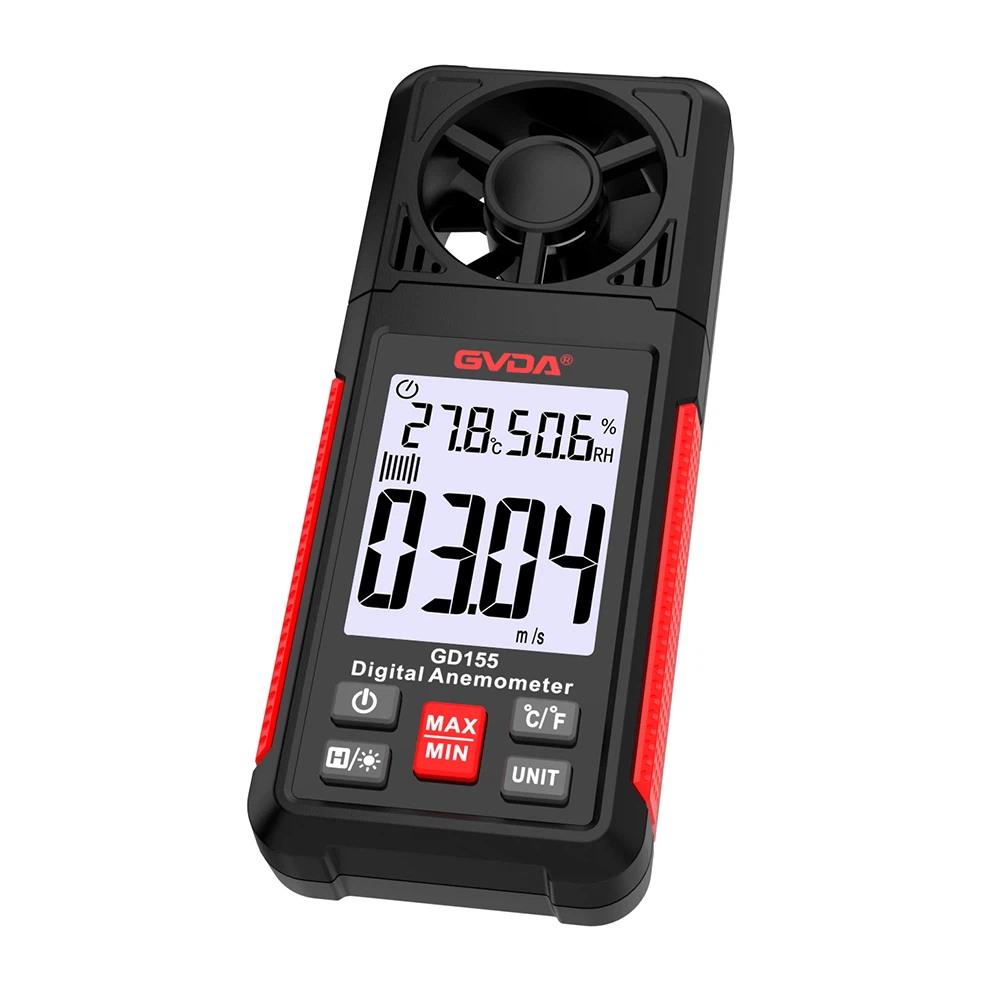
Rotary Vane Probe of AnemometerThe rotary vane probe converts mechanical rotation into electrical signals. A proximity sensor counts vane rotations and generates a pulse sequence, which is processed by the detector to calculate rotational speed.
Large-diameter probes (60 mm, 100 mm) are suitable for measuring turbulent flow at medium and low velocities, such as at duct outlets. Small-diameter probes are ideal for airflow measurement where the duct cross-sectional area is more than 100 times that of the probe cross-section.