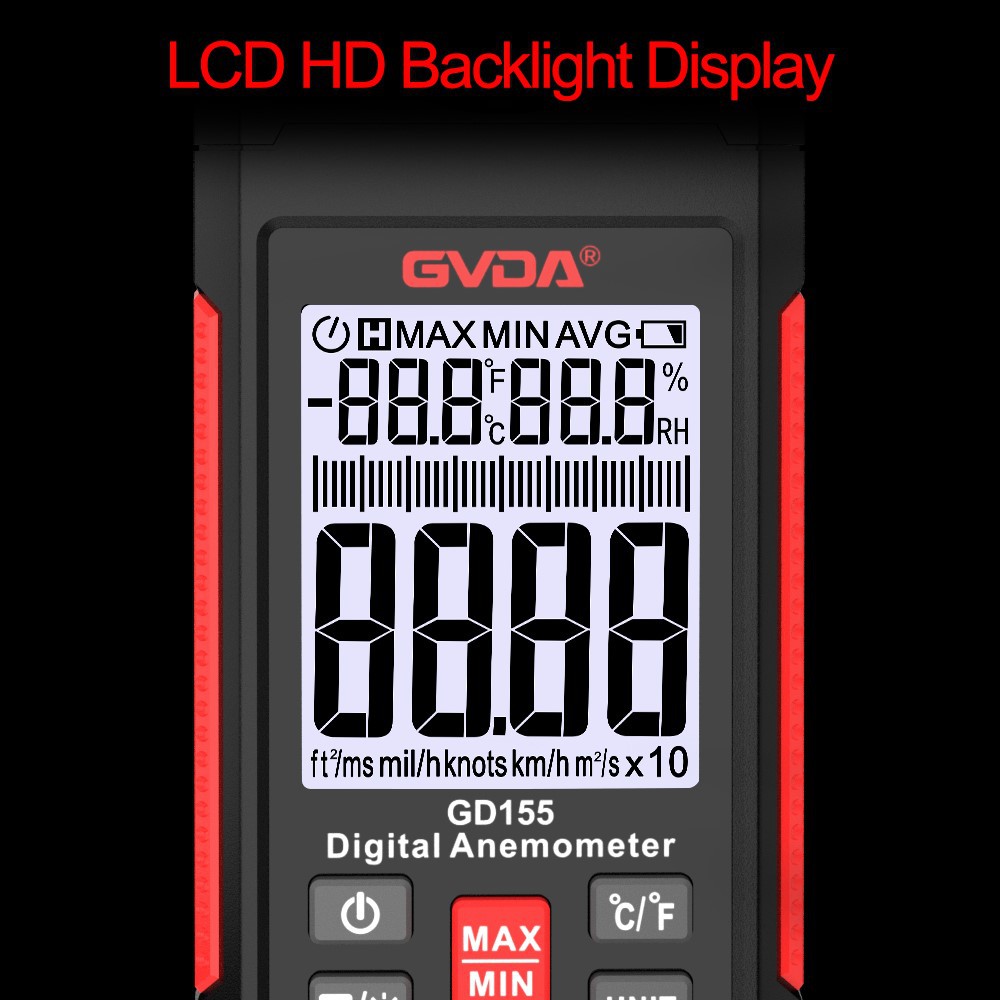
Several Testing Methods of Digital Anemometers
Digital anemometer tests include average wind speed measurement and turbulence component measurement (wind turbulence: 1~150 kHz, different from regular fluctuations).Common methods for measuring average wind speed include the thermal type, ultrasonic type, impeller type and pitot tube type.
The thermal method measures wind speed by detecting the resistance change of a powered sensor when cooled by airflow. It cannot provide wind direction data. Featuring portability and high cost‑performance, it is widely adopted as a standard anemometer product.Sensing elements of thermal anemometers may use platinum wire, thermocouples or semiconductors. Our company adopts platinum coiled wire, which delivers excellent material stability. It offers superior long‑term stability and reliable temperature compensation performance.
The wind direction sensor of the photoelectric anemometer adopts a low‑inertia light‑metal wind vane to respond to wind direction and drive the coaxial code disc to rotate. The code disc is encoded with Gray code and scanned by optoelectronic components to output electrical signals corresponding to wind direction.
The photoelectric wind speed sensor uses low‑inertia wind cups that rotate with the wind and drive the coaxial shutter disc. Optoelectronic scanning outputs pulse trains, and the pulse frequency corresponds to the rotational speed for easy data collection and processing. It features high structural strength, sensitive startup performance and compliance with national meteorological measurement standards.
Built with an electronic compass, the wind direction sensor can automatically locate the azimuth angle. It is applicable to both fixed installation sites and mobile scenarios such as special vehicles, ships and drilling platforms.
Rotary Probe of Digital Anemometer
The working principle of the rotary probe is to convert mechanical rotation into electrical signals. A proximity sensor counts the rotations of the impeller and generates a pulse sequence. The processing unit converts the signals to obtain the rotational speed.Large‑diameter probes (60 mm, 100 mm) are suitable for measuring medium and low‑velocity turbulent flow, such as airflow at duct outlets. Small‑diameter probes are more suitable for airflow measurement where the cross‑sectional area of the duct is more than 100 times that of the probe.