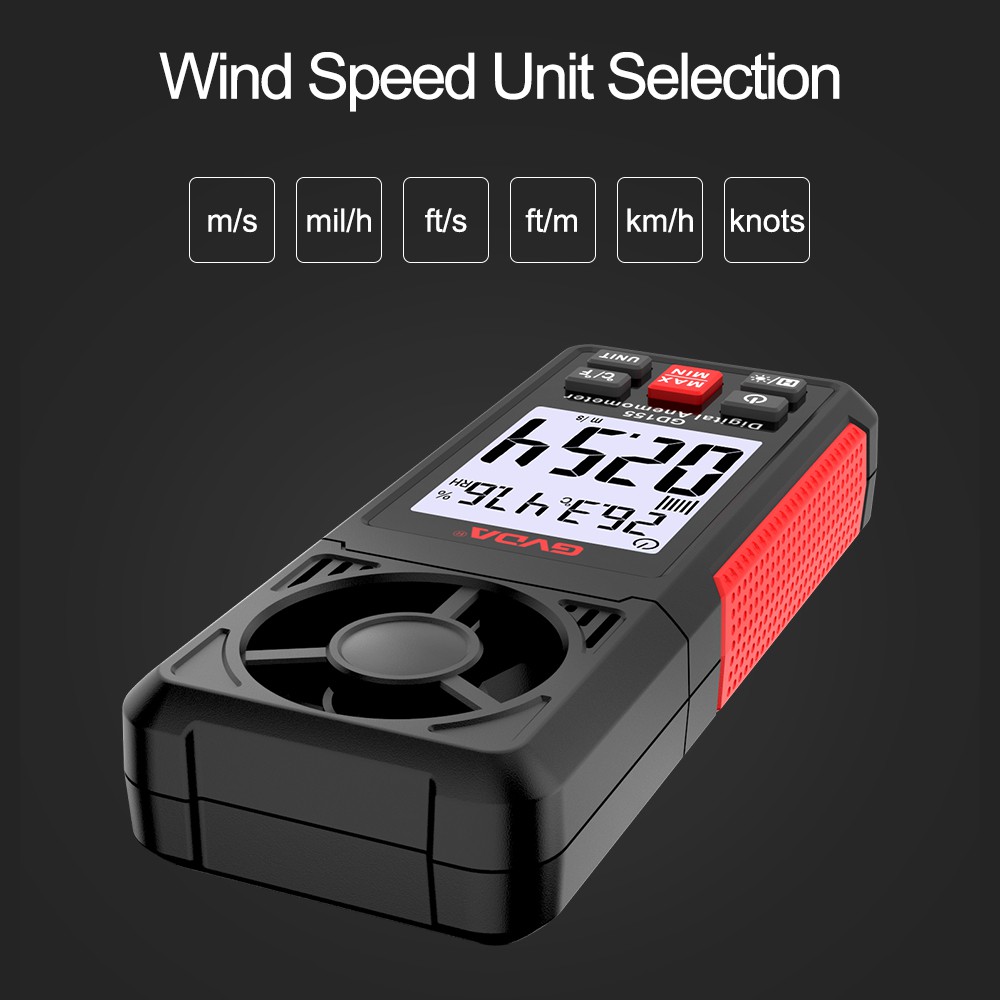
What is the function of the impeller anemometer?
Common instruments for wind speed measurement include cup anemometers, vane anemometers, katathermometers and hot‑ball electric anemometers. Vane and cup anemometers are easy to operate, yet they feature high inertia and large mechanical friction resistance, making them only suitable for measuring relatively high wind speeds.
Hot‑ball Electric Anemometer
1. Structure and Working Principle
This instrument is designed for low wind speed measurement, with a measuring range of 0.05–10 m/s. It consists of two parts: a hot‑ball probe rod and a measuring meter. The probe is fitted with a glass ball of 0.6 mm in diameter. Inside the ball, a nichrome heating coil and two series‑connected thermocouples are installed. The cold junctions of the thermocouples are fixed on phosphor copper supports and directly exposed to airflow.
When a fixed current passes through the heating coil, the temperature of the glass ball rises. The temperature rise is correlated with wind speed: the temperature increases more significantly at low wind speeds, and less noticeably at high wind speeds. The temperature variation is converted into readings on the meter via thermocouples. The actual wind speed (m/s) can be determined by checking the calibration curve against the meter reading.
2. Operating Instructions
① Before use, check whether the meter pointer points to zero. If offset, gently adjust the mechanical screw to reset the pointer to the zero position.② Set the calibration switch to the OFF position.③ Insert the probe rod plug into the socket, place the rod vertically upward, and fasten the screw plug to seal the probe. Turn the calibration switch to the full‑scale position, then slowly adjust the full‑scale knob to align the pointer with the full scale.④ Switch the calibration knob to the zero position, and slowly adjust the coarse and fine tuning knobs to set the meter pointer to zero.⑤ After completing the above steps, pull out the screw plug gently to expose the probe (the extension length is adjustable as required). Aim the red dot on the probe against the incoming wind. Check the calibration curve according to the meter reading to obtain the measured wind speed.⑥ Repeats steps ③ and ④ approximately every 10 minutes during continuous measurement to standardize the internal current of the instrument.⑦ After measurement, set the calibration switch to the OFF position.
3. Precautions
① This is a precision instrument. Avoid collision and vibration. Do not operate it in dusty or corrosive environments.② The instrument is powered by four batteries divided into two groups: three batteries connected in series and one single battery. If the meter fails to reach full scale during full‑scale adjustment, the single battery is exhausted. If the pointer cannot return to zero during coarse and fine tuning, the three series batteries need replacement. To replace batteries, open the bottom cover and install new batteries in the correct polarity.③ Recalibration is mandatory after any instrument maintenance.