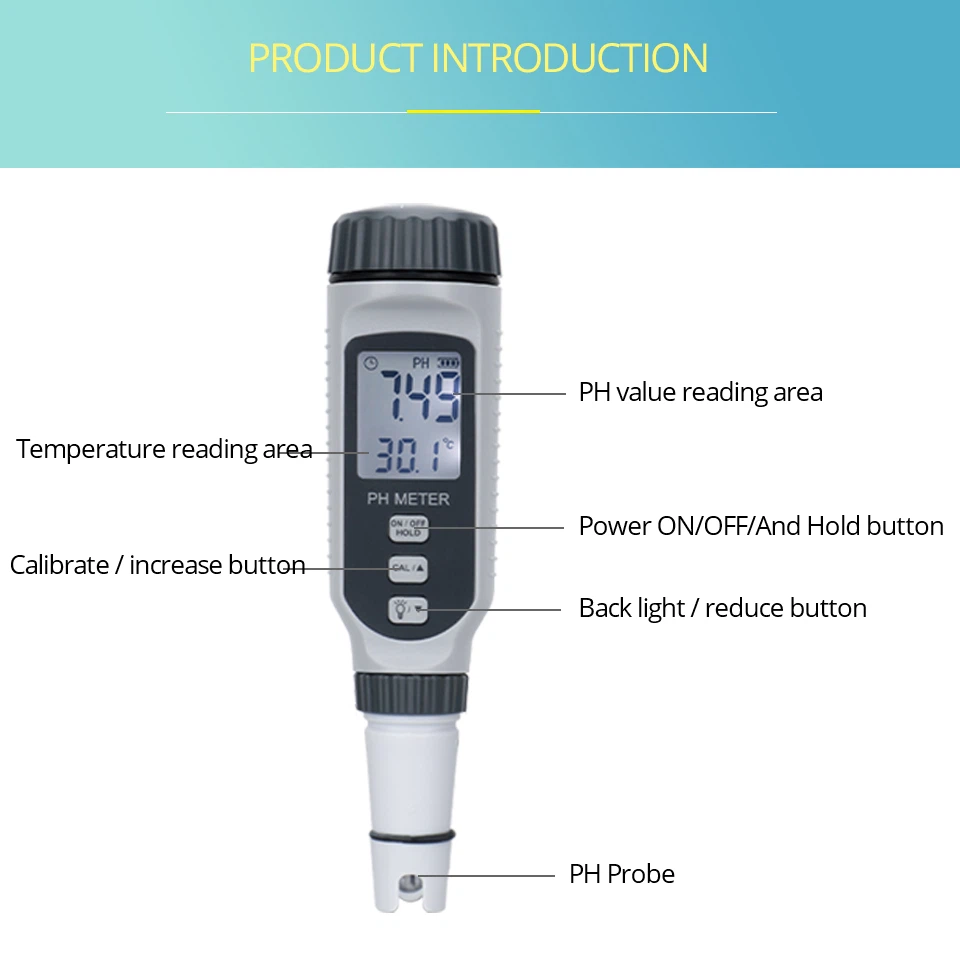
Three ways to repair the pH electrode?
The "damage" of the pH composite electrode, the phenomenon is that the sensitive gradient is reduced, the response is slow, and the repeatability of the reading is poor. It may be caused by the following three factors. Generally, customers can use appropriate methods to repair it.
1. The electrode bulb and liquid junction are polluted, and the dirt can be carefully removed with a fine brush, cotton or toothpick. The protective cover of some plastic shell electrode heads can be unscrewed, which is convenient for cleaning. If the pollution is serious, it can be cleaned with detergent according to the method in Article 8.
2. The external reference solution is polluted. Some electrode structures can be added to the solution. At this time, the external reference solution of the electrode can be pumped out with a syringe, and a new 3.3mol/L or saturated KCL solution is prepared, and then added. Note that it must be pulled out when it is added for the first and second time, so as to clean the inner cavity of the electrode.
3 Aging of glass sensitive film: Soak the electrode bulb in 0.1mol/L dilute hydrochloric acid (9mL hydrochloric acid diluted to 100mL with pure water) for 24 hours, wash it with pure water, and then soak it in the electrode soaking solution for 24 hours. If the passivation is serious, you can also soak the lower end of the electrode in 45 hydrofluoric acid solution for 3-5 seconds (solution preparation: dilute 4 mL hydrofluoric acid to 100 mL with pure water), wash it with pure water, and then Soak the electrode in the soaking solution for 24 hours to restore its performance.
How Much Does Temperature Affect pH Accuracy Measurements?
For pH electrodes, temperature affects each pH by 0.003pH/°C. For example, a 0.2-grade pH meter is calibrated in a pH buffer solution at 30°C, and then the solution at 60°C is tested (assuming that the pH range of the solution is between pH 6-8) The difference between pH 7.00 and pH 7.00 is one pH unit), then the maximum error affected by temperature is 30×0.003=0.09pH. If it is 3 pH units (in the pH4-10 range), the maximum error is 0.27pH, from which it can be seen that the temperature has a great influence on the pH. Of course, we can also draw conclusions from it. In order to reduce the error of temperature to pH measurement, we should pay attention to the following three points:
1. Try to select a buffer solution close to the pH value of the solution to be measured to calibrate the pH meter.
2 Try to make the temperature of the calibration solution the same or close to the temperature of the measured solution.
3 A pH meter with temperature compensation should be selected.
pH meters with an accuracy higher than 0.1pH have temperature compensation adjustments, while pH meters with a grade of 0.2 do not have temperature compensation. Some 0.2-grade pH meters also claim to have 0.1-grade accuracy. In fact, this is impossible. Some people confuse the two concepts of resolution 0.1pH and precision 0.1pH. Even in terms of one pH unit, the pH error at a distance of 60°C is 0.003×60=0.18pH. Therefore, the highest accuracy of a pH meter without temperature compensation is only 0.2pH.