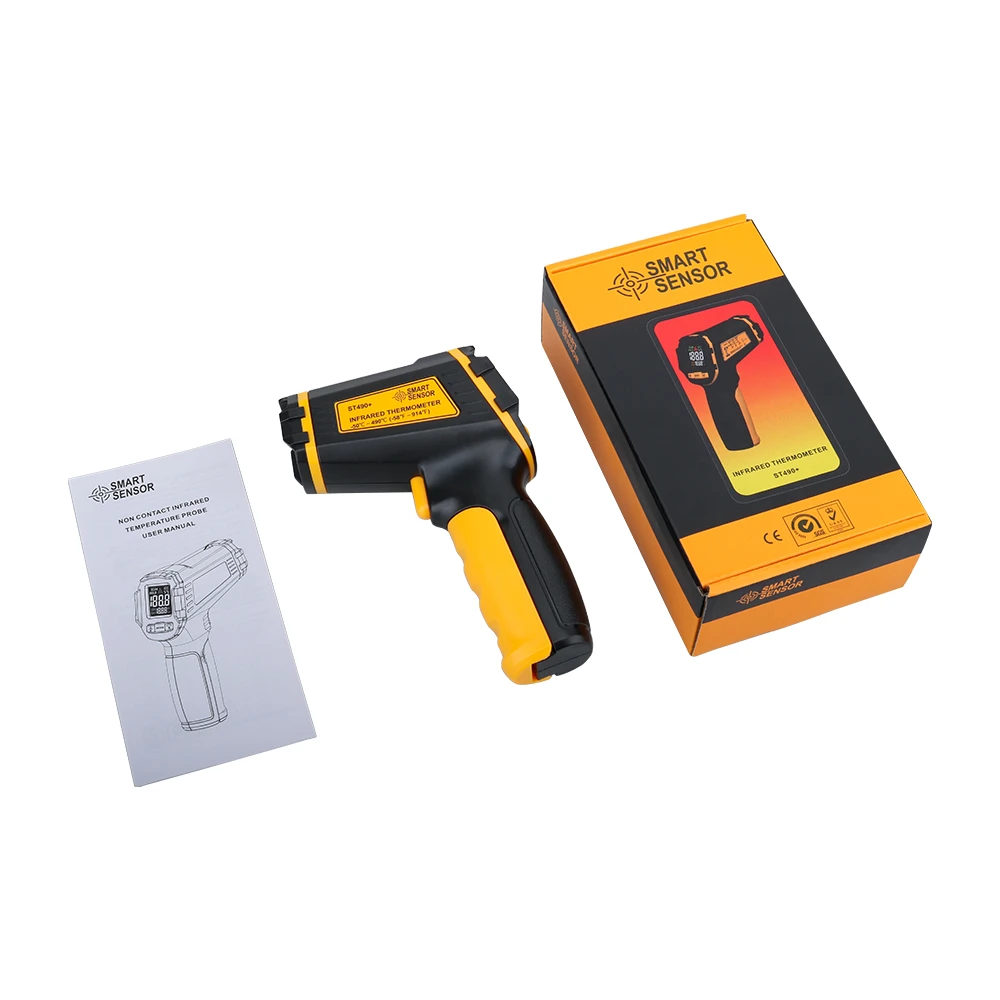
Tips for Adjusting the Emissivity of Infrared Thermometers
Any infrared radiation, once emitted, will be absorbed; therefore, absorptivity equals emissivity. What an infrared thermometer reads is the infrared radiant energy emitted by the object's surface. It cannot capture infrared radiant energy lost in the air. Thus, transmittance can be ignored in practical measurement. This yields the basic formula for infrared radiation measurement: Infrared radiant rate = Emissivity − Reflectivity
Reflectivity is inversely proportional to emissivity. The stronger an object's ability to reflect infrared radiation, the weaker its capacity to emit infrared radiation. Reflectivity can be roughly estimated by visual inspection. New copper has high reflectivity and low emissivity (0.07–0.2). Oxidized copper has lower reflectivity and higher emissivity (0.6–0.7). Copper darkened by heavy oxidation features even lower reflectivity and correspondingly higher emissivity (0.88). Most painted surfaces have very high emissivity (0.9–0.95), and their reflectivity can be neglected.
For most infrared thermometers, the key parameter to set is the rated emissivity of the measured material. This value is usually preset to 0.95, which is sufficient for measuring organic materials or painted surfaces.
Adjusting the emissivity of the thermometer compensates for insufficient infrared radiant energy on surfaces of some materials, especially metals. The influence of reflectivity on measurement shall only be considered when high-temperature infrared radiation sources exist near the measured surface and produce reflections.
Infrared (IR) Radiation
Infrared radiation exists everywhere continuously. The greater the temperature difference between objects, the more obvious the radiation phenomenon. Infrared radiant energy from the sun travels 93 million miles through vacuum to the Earth, where it is absorbed and delivers heat. When standing in front of a refrigerated food cabinet in a shopping mall, the infrared heat radiated by our bodies is absorbed by the cold food, creating a cool sensation. These two examples demonstrate obvious radiation effects, whose changes can be clearly perceived.
Quantifying infrared radiation effects requires temperature measurement with an infrared thermometer. Different materials exhibit distinct infrared radiation characteristics. Before reading temperatures with an infrared thermometer, it is necessary to understand the basic principles of infrared radiation measurement and the infrared radiation properties of the target material.