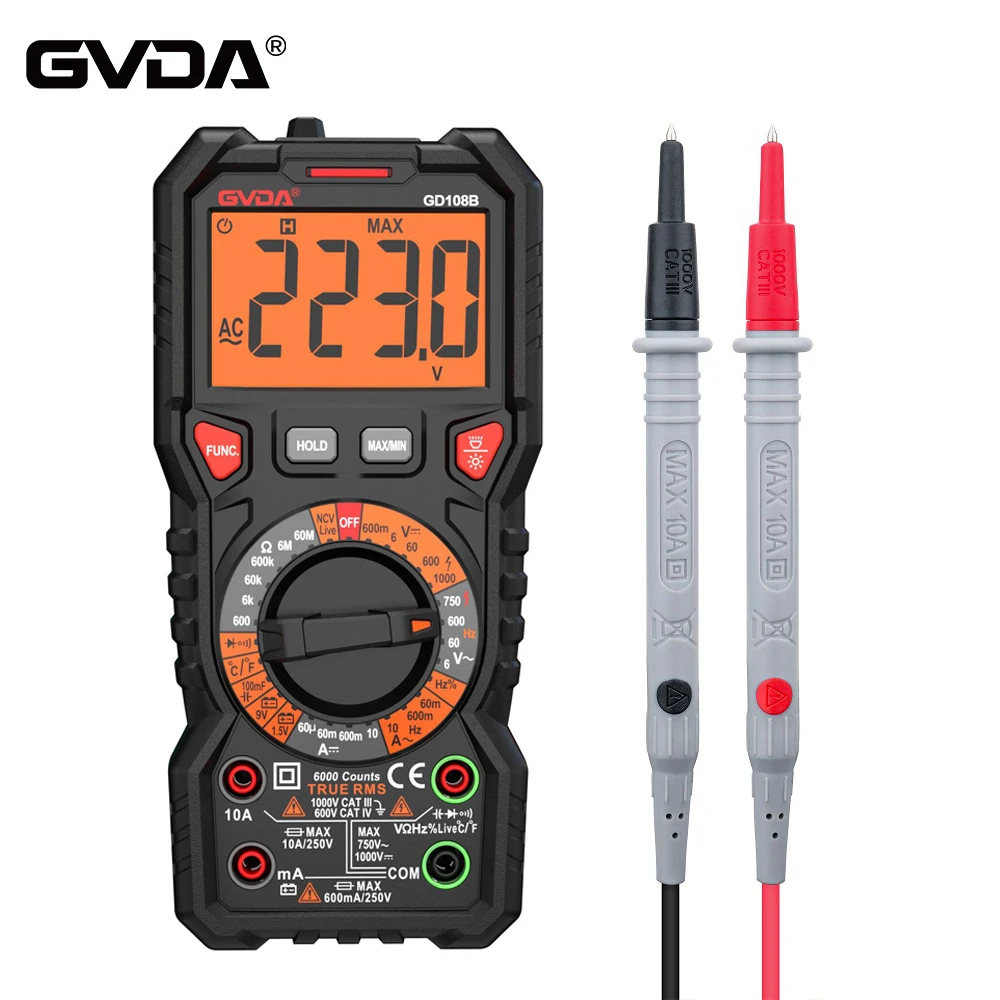
Tips for Measuring Earth Resistance with a Multimeter
In many applications, ground electrodes must be buried and ground‑leads brought out for reliable earthing of instruments and equipment. To verify that the earth resistance meets specifications, dedicated earth‑resistance testers (e.g., Kyoritsu 4105A, Japan) are normally required.
In practical field‑work, however, dedicated earth‑resistance testers can be expensive and hard to obtain. Is it possible to measure earth resistance with a multimeter? The author has conducted multimeter‑based earth‑resistance tests in soils of different textures and compared the readings with those from a dedicated earth‑resistance tester. Results show good agreement between the two sets of data. The detailed measuring procedure is described below.
Obtain two steel round bars of 8 mm diameter and 1 m length. Sharpen one end of each bar to make auxiliary test stakes. Drive them into the ground at positions 5 m away on each side of the Device‑Under‑Test ground electrode A, to a depth of no less than 0.6 m. Arrange A, B and C in a straight line.
Here, A is the ground electrode under test; B and C are auxiliary test stakes.
Set the multimeter to the ×1 resistance range. Measure the resistance between A‑B, A‑C and B‑C, denoted as RAB, RAC and RBC respectively. The earth resistance of electrode A can then be calculated.
Earth resistance is defined as the contact resistance between a ground electrode and surrounding soil. Let RA, RB and RC represent the earth resistances of electrodes A, B and C respectively. Let RX stand for the soil resistance between A and B. Since the distance AC equals AB, the soil resistance between A and C is also RX. As BC = 2 × AB, the soil resistance between B and C approximates to 2RX.
Thus: ① RAB = RA + RB + RX ② RAC = RA + RC + RX ③ RBC = RB + RC + 2RX
Add equations ① and ②, then subtract equation ③: RA = (RAB + RAC − RBC) / 2 ④
Equation ④ is the formula for calculating earth resistance.
Practical example: Measured values for a certain ground electrode: RAB = 8.4 Ω, RAC = 9.3 Ω, RBC = 10.5 Ω.
RA = (8.4 + 9.3 − 10.5) / 2 = 3.6 Ω
Therefore, the earth‑resistance value of the measured ground electrode A is 3.6 Ω.
Important note: Before measurement, polish the surfaces of ground electrodes A, B and C with sandpaper until bright. Minimize contact resistance between test‑probe tips and electrodes to reduce measurement errors.