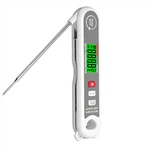
Tips for Selecting a Coating Thickness Gauge
Aluminum profiles: Affected by the country’s implementation of mandatory standards and the renewal of licenses by profile companies since the beginning of this year, the industry has shown a good momentum. It mainly measures the oxide film on the profiles. It is understood that for every micron less coating by the production enterprises, one ton of profiles is “saved” 150 yuan is very considerable, so the country mandates that relevant testing equipment including coating thickness gauges be equipped. This move also brought us a very good opportunity. This opportunity has also attracted the attention of competitors, who have lowered the price to the greatest extent, and quickly launched an offensive in this industry by taking various methods such as distribution of goods.
The application industries of coating thickness gauges are distributed in electroplating, spraying; pipeline anticorrosion; aluminum profiles; steel structures; printed circuit boards, and screen printing, etc.
Electroplating and spraying: This industry uses our instruments the most, accounting for a considerable proportion of annual sales, and it is our main user group, which requires energy to continue to dig.
Steel structure: For our products, this type of enterprise can also be classified as an industry alone. Coating thickness gauges are indeed widely used in this industry, and manufacturers including iron towers also have more recent purchase information;
Pipeline anticorrosion: there are many users mainly in petrochemical industry, generally the anticorrosion layer is relatively thick, and there are many users of LKTC-4 thickness gauge;
Choosing a suitable coating thickness gauge with high performance is very helpful to the work process and can effectively improve work efficiency.
Coating thickness gauge generally has the following five types according to the measurement principle:
1. Magnetic thickness measurement method: It is suitable for measuring the thickness of the non-magnetic layer on the magnetically conductive material. The magnetically conductive material is generally: steel\iron\silver\nickel. This method has high measurement accuracy
2. Eddy current thickness measurement method: suitable for measuring the thickness of non-conductive layer on conductive metal. This method is less accurate than magnetic thickness measurement method
3. Ultrasonic thickness measurement method: At present, there is no such method in China to measure the thickness of the coating. Some foreign manufacturers have such instruments, which are suitable for the measurement of the thickness of multi-layer coatings or the occasions where the above two methods cannot be measured. But it is generally expensive and the measurement accuracy is not high.
4. Electrolytic thickness measurement method: This method is different from the above three methods. It does not belong to non-destructive testing and needs to destroy the coating. The general accuracy is not high. It is more troublesome to measure than other types
5. Radiation thickness measurement: This kind of instrument is very expensive (generally above 100,000 RMB), and is suitable for some special occasions.
The first and second methods are the most commonly used in China at present.
Example: dual-purpose coating thickness gauge
The instrument is produced in Germany. It combines the functions of magnetic thickness gauge and eddy current thickness gauge. It can be used to measure the thickness of coatings on ferrous and non-ferrous metal substrates. like:
* Copper, chromium, zinc and other electroplating layers or paint, paint, enamel and other coating thicknesses on steel.
*Thickness of anodized film on aluminum and magnesium materials.
* Coating thickness on copper, aluminum, magnesium, zinc and other non-ferrous metal materials.
*Thickness of aluminum, copper, gold and other foil strips, paper and plastic films.
*Thickness of thermal spray coating on various steel and non-ferrous metal materials.
The instrument complies with national standards GB/T4956 and GB/T4957, and can be used for production inspection, acceptance inspection and quality supervision inspection. *Dual-function built-in probe is used to automatically identify ferrous or non-ferrous matrix materials, and select the corresponding measurement method for precise measurement.
*Ergonomically designed dual-display structure can read measurement data at any measurement position.
*The mobile phone menu-style function selection method is adopted, and the operation is very simple.
*The upper and lower limit values can be set. When the measurement result exceeds or meets the upper and lower limit values, the instrument will emit a corresponding sound or flashing light to prompt.
*Extremely stable, usually can be used for a long time without calibration