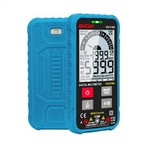
Troubleshooting and handling skills of digital multimeter
1. Repair method of digital multimeter
When looking for faults, you should start from the outside and then the inside, first easy and then difficult, break the whole into parts, and make breakthroughs in key points. The methods can be roughly divided into the following categories:
1. Feeling method
Use the senses to directly judge the cause of the failure. Through visual inspection, you can find such as disconnection, desoldering, short circuit, broken fuse tube, burnt components, mechanical damage, copper foil lifting and fracture on the printed circuit, etc. ; You can touch the temperature rise of the battery, resistors, transistors, and integrated blocks, and you can refer to the circuit diagram to find out the reason for the abnormal temperature rise.
In addition, by hand, you can also check whether the components are loose, whether the integrated circuit pins are firmly inserted, and whether the transfer switch is stuck; you can hear and smell whether there are abnormal sounds and odors.
2. Voltage measurement method
Measuring whether the working voltage of each key point is normal can quickly find out the fault point. Such as measuring the working voltage and reference voltage of the A/D converter.
3. Short circuit method
In the method of checking the A/D converter mentioned above, the short-circuit method is generally used, and this method is often used when repairing weak and micro-electric instruments.
4. Circuit breaking method
Disconnect the suspicious part from the whole machine or unit circuit. If the fault disappears, it means that the fault is in the disconnected circuit. This method is mainly suitable for the situation where there is a short circuit in the circuit.
5. Measuring element method
When the fault has been narrowed down to one or a few components, it can be measured online or offline. If necessary, replace it with a good one. If the fault disappears, the component is broken.
6. Interference method
Use the human body induced voltage as the interference signal to observe the changes of the liquid crystal display. It is often used to check whether the input circuit and the display part are intact.
Second, digital multimeter repair skills
For a faulty instrument, first check and judge whether the fault phenomenon is common (all functions cannot be measured) or individual (individual function or individual range), and then distinguish the situation and solve it symptomatically.
1. If all gears fail to work, focus on checking the power circuit and A/D converter circuit.
When checking the power supply part, you can remove the laminated battery, press the power switch, connect the positive test lead to the negative of the power supply of the meter under test, and the negative test lead to the positive power supply (for digital multimeters), and switch to the diode measurement position. If the forward voltage of the diode is higher, it means that the power supply part is good. If the deviation is large, it means that there is a problem with the power supply part.
If there is an open circuit, focus on checking the power switch and battery leads.
If there is a short circuit, you need to use the open circuit method to gradually disconnect the components that use the power supply, and focus on checking the operational amplifier, timer and A/D converter. In the event of a short circuit, generally more than one integrated component is damaged.