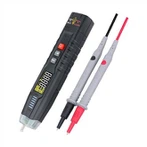
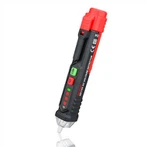
Troubleshooting digital multimeters generally starts with the power supply
1. Visual inspection.
You can touch the temperature rise of the battery, resistor, transistor, and integrated block by hand to see if it is too high. If the newly installed battery heats up, it indicates that the circuit may be short circuited. In addition, it is necessary to observe whether the circuit is disconnected, desoldered, mechanically damaged, etc.
2. Waveform analysis.
Observe the voltage waveform, amplitude, period (frequency), etc. of each key point in the circuit using an electronic oscilloscope.
For example, if the clock oscillator is not oscillating and there is no output from the oscillator, it indicates that the internal inverter is damaged, or it may be due to an open circuit in external components.
3. Measure component parameters.
For components within the fault range, online or offline measurements should be conducted, and parameter values should be analyzed. When measuring resistance online, the influence of the components connected in parallel with it should be considered.
4. Hidden fault elimination.
Implicit faults refer to faults that appear and disappear from time to time, and the instruments are sometimes good or bad. This type of malfunction is quite complex, and common causes include solder joints being poorly soldered, loose, loose connectors, poor contact of the adapter switch, unstable component performance, and continuous breakage of leads. In addition, it also includes factors caused by external factors. If the ambient temperature is too high, humidity is too high, or there are intermittent strong interference signals nearby, etc.
5. Detect the working voltage at all levels.
Detect the working voltage at each point and compare it with the normal value. Firstly, ensure the accuracy of the reference voltage. It is best to use a digital multimeter of the same model or similar for measurement and comparison.
In addition to ruling out the above possible reasons, the damage to the digital multimeter may also be caused by an error in the measurement gear. For example, when measuring AC mains power, the measurement gear is selected to be in the resistance gear. In this case, once the probe contacts the mains power, it can instantly cause damage to the internal components of the multimeter.
Therefore, before using a multimeter for measurement, it is necessary to check whether the measurement gear is correct. After use, place the measurement selection at AC 750V or DC 1000V, so that no matter what parameter is mistakenly measured in the next measurement, it will not cause damage to the digital multimeter.