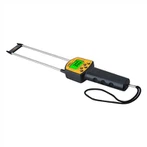
Use moisture tester to test wood moisture and wood properties
1. The source and state of moisture in wood
When a living tree grows, its roots continuously absorb water from the soil, and the xylem of the trunk sends water to various organs of the tree, and at the same time, the nutrients produced by photosynthesis of leaves are transported from the phloem of the trunk to various organs of the tree. part. Moisture is not only the most important substance for tree growth, but also the carrier for trees to transport various substances. After the living tree is felled and sawn into various specifications of boards and squares, most of the water still remains inside the wood, which is the moisture in wood. At the same time, wood will also absorb some moisture into its interior during storage, transportation or use.
For different tree species, the moisture content of xylem in the trunk is different. Even the same tree has different water content in its xylem in different growing seasons. Each part of xylem, such as heartwood, sapwood, root, trunk and treetop, has different water content, so the water distribution in wood is very uneven. When the atmospheric conditions around the wood change, its moisture content will also change accordingly. The moisture can be divided into three types: free water, adsorbed water, and combined water because of its different positions in the wood:
(1) Free water exists in the large capillary system composed of the pits on the wood cell wall or the perforation at the end of the conduit, the cell cavity and the intercellular space. The free water is physically combined with the wood, and the combination is not tight. This part of the water It is easy to escape from the wood, and it is also easy to inhale. When wet wood is placed in dry air, the first thing to evaporate is free water. For freshly felled raw wood, the free water content of different tree species varies greatly, generally Between 60~70% and 200~250%.
(2) Adsorbed water exists in the micro-capillary system formed between the microfibrils and macrofibrils in the wood cell wall or adsorbed on the free radicals of cellulose molecules on the surface of the microcrystal and in the amorphous region. Adsorbed water in wood There is little difference in the content among tree species. The maximum content of water absorbed by wood is generally between 23% and 31%, and the average is about 3%. The water absorbed is closely combined with the wood substance, and this part of water is not easy to escape from the wood. Only When the free water in the wood evaporates completely, and the partial pressure of water vapor in the wood is greater than the partial pressure of water vapor in the surrounding wall air, it can evaporate from the wood.
(3) Combination water and cell wall components are in a strong chemical combination state. The content of this part of water in wood is very small and can be ignored, and it cannot be removed under normal dry conditions.
2. Wood moisture and indoor environment
In the indoor environment where people live, the humidity should not fluctuate too much, and should be stable within a certain range, which is very beneficial to personal health and the preservation of objects. Research data show that: the relative humidity range for preventing wet mold is 0-80%; for preventing insect damage, it is 0-70% or 80-100%; for preserving books, it is 40-60%; for preventing bacterial infection, it is 55-60%; The lowest rate is 60-70%, and the relative humidity of the human living environment should be around 60, which is more suitable.
There are many factors that cause changes in indoor humidity, for example: external temperature changes or indoor temperature changes will cause humidity changes; water vapor flowing in or out from the transom or ventilation openings, water vapor penetrating through the wall, water vapor coming in from the kitchen, etc. It can also cause changes in humidity.
The humidity-regulating property of wood is one of the unique properties of wood, and it is also the advantage of it as an interior decoration material and furniture material. The humidity change of houses decorated with wood or wood materials is much faster than that of concrete houses or houses decorated with wallpaper. Small. The so-called moisture-regulating characteristics of wood is to directly alleviate the humidity change of the indoor environment by the moisture absorption and desorption of the wood itself. When the relative humidity of the indoor environment decreases, the water vapor partial pressure balance between the indoor environment and the wood is broken. The water vapor partial pressure inside the wood is higher than that of the indoor environment, and the moisture inside the wood will escape. Increase the relative humidity of the indoor environment, which is the desorption process. Conversely, when the relative humidity of the indoor environment increases, wood will absorb moisture from the indoor air, which is a hygroscopic process. At the beginning of the desorption or moisture absorption process, the wood proceeds very strongly, after which it gradually slows down until a new dynamic equilibrium is reached. Here wood acts as a storage of moisture, just like a natural regulator of indoor air humidity. People have been accustomed to living in the environment of wooden furniture and wooden interior decoration materials for a long time.
3. The moisture content of wood and the shape and size of its products
The moisture content of wood affects the strength, rigidity, hardness, decay resistance, mechanical processing performance, combustion value, thermal conductivity, electrical conductivity, etc. of wood within a certain range.
When wet wood is placed in a dry environment, since the partial pressure of water vapor in the wood is greater than the partial pressure of atmospheric water vapor, the water will be released from the inside of the wood to the atmosphere, and the free water will evaporate first. When the free water in the wood evaporates completely and the adsorbed water is still in a saturated state, the moisture content state of the wood is called the fiber saturation point, and the fiber saturation point is the turning point of the change of wood properties. When the moisture content of wood changes above the fiber saturation point, because the change of moisture is only the increase or decrease of the amount of free water, and the increase or decrease of the amount of free water has little effect on the properties of wood, only affecting the weight, combustion value, thermal conductivity and conductivity. Conversely, when the moisture content of wood changes below the fiber saturation point, because there is no free water inside the wood, the change in the amount of absorbed water has a great influence on the properties of wood, such as the mechanical properties of wood, drying shrinkage, swelling, thermal conductivity and electrical conductivity. It can be said that the amount of water absorbed in wood is the main factor affecting the properties of wood.
In addition, when there is a suitable environment such as air, nutrients, temperature, and humidity, the spores of the wood-rot fungus will infect the wood and cause harm to the wood. The optimum temperature for the growth of most wood-rot fungi is 25-30°C, and the optimum moisture content is 35-50%. If the moisture content of wood is reduced to 2%, the activity of wood-rot fungi will be inhibited, so drying is also to prevent wood from discoloring Effective measures of decay.
In our daily life, what we experience most is the dry shrinkage and wet expansion characteristics of wood, which is a remarkable feature of wood. After the newly felled trees are sawn into boards and squares, they will start to emit moisture when placed in a relatively dry environment. First, the free water in the wood will start to escape, and the size of the wood will not change accordingly. When the free water in the wood evaporates, the adsorbed water in the wood cell wall is discharged from the wood, and the size of the wood decreases. This is because the gap between the microfibrils and macrofibrils in the cell wall is reduced due to the discharge of absorbed water, which makes the cell wall thinner and causes the wood to shrink. On the contrary, when the wood is gradually wetted from the completely dry state to the fiber saturation point, the phenomenon of wood swelling can be observed.
The drying shrinkage and wet expansion of wood make the dimensions of wood products unstable. Due to the anisotropy of wood structure, wood shrinkage varies greatly due to differences in direction, tree species, density, latewood rate, growth ring width, stress wood, and chemical composition of cell walls. Therefore, the drying shrinkage and wet expansion of wood also present anisotropy, which is mainly manifested in that the longitudinal shrinkage rate along the trunk direction is very small, about 0.10~0.20, and the radial shrinkage rate along the trunk radius direction is about 3~ 6%; the chord shrinkage rate of wood along the annual ring direction is about twice the radial shrinkage rate, about 6~12%, because the uneven shrinkage of each part changes its shape.
When the raw wood is dry, due to the combined effect of the difference in shrinkage in the radial direction and the chord direction, the end face of the plank square lumber unsawed from the log will undergo various deformations, such as warping, bending, twisting, and transverse bending. Due to the uneven drying and the difference in shrinkage in different directions, the wood will cause cracks, end cracks, surface cracks, heart cracks, honeycomb cracks, wheel cracks and other defects.
The equilibrium moisture content of wood is of great significance in wood processing and utilization. Its role is that it makes people realize that before wood is made into wood products, it must be dried to the wood equilibrium moisture content that is suitable for the air temperature and humidity in the area. In this way, changes in the moisture content of the wood due to the influence of temperature and humidity in the area of use can be avoided, and it will not cause changes in the size or shape of the wood, thereby ensuring the quality of wood products. Our country has a vast territory, and the equilibrium moisture content of wood in various regions varies greatly depending on the climate of each region. Even in the same area, the equilibrium moisture content of wood in different seasons also varies. For example, the average annual average moisture content of wood in Beijing is about 11.1%, the highest is 15.6% in August, and the lowest is about 8.5% in April.