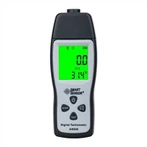
Precautions for the use of the multimeter
(1) Before using the multimeter, "mechanical zero adjustment" should be performed first, that is, when there is no electricity to be measured, make the pointer of the multimeter point to the position of zero voltage or zero current.
(2) In the process of using the multimeter, do not touch the metal part of the test pen with your hands, which can ensure the accuracy of the measurement on the one hand, and personal safety on the other hand.
(3) When measuring a certain amount of electricity, it is not possible to change gears while measuring, especially when measuring high voltage or large current, more attention should be paid. Otherwise, the multimeter will be damaged. If you need to change gears, you should disconnect the test leads first, and then go to measure after changing gears.
(4) When using the multimeter, it must be placed horizontally to avoid errors. At the same time, pay attention to avoid the influence of external magnetic field on the multimeter.
(5) After the multimeter is used, the transfer switch should be set to the maximum value of the AC voltage. If it is not used for a long time, the battery inside the multimeter should also be taken out to prevent the battery from corroding other devices in the meter.
The use of ohm stops
1. Select the appropriate magnification. When measuring resistance with an ohmmeter, an appropriate magnification should be selected so that the pointer indicates near the median value. Do not use the left third of the scale, which is poorly dense.
2. Zero adjustment before use.
3. Do not measure with electricity.
4. The resistance under test cannot have parallel branches.
5. When measuring the equivalent resistance of polar components such as transistors and electrolytic capacitors, you must pay attention to the polarities of the two pens.
6. When measuring the equivalent resistance of the nonlinear element with the ohm stop of different magnifications of the multimeter, the measured resistance value is not the same. This is because the median resistance and full-scale current of each gear are different. In a mechanical watch, the smaller the magnification, the smaller the measured resistance.
When a multimeter measures DC:
1. Perform mechanical zero adjustment.
2. Select the appropriate range gear.
3. When using the current block of the multimeter to measure the current, the multimeter should be connected in series in the quilt circuit, because only the series connection can make the current flowing through the ammeter to be the same as the current of the branch under test. When measuring, the branch under test should be disconnected, and the red and black test leads of the multimeter should be connected in series between the two disconnected points. In particular, it should be noted that the ammeter cannot be connected in parallel in the quilt test circuit, it is very dangerous, and it is very easy to burn the multimeter.
4. Pay attention to the polarity of the measured electricity.
5. Correct use of scales and readings.
6. When the 2. block of DC current is selected, the red test lead of the multimeter should be inserted into the 2. measurement jack, and the range switch can be placed on any range of the DC current block.
7. If the DC current measured by the quilt is greater than 2., the 2. block can be extended to block . The method is very simple, the user can connect a 0.24 ohm resistor between the "2." jack and the black test pen jack, so that the gear becomes a current gear. The connected 0.24A resistor should be a wire-wound resistor of more than 2W. If the power is too small, it will burn out.
The three basic functions of a multimeter are to measure resistance, voltage, and current, so the seniors call it a three-meter. Today's multimeters have added many new functions, especially digital multimeters, such as measuring capacitance value, triode magnification, diode voltage drop, etc.
The biggest feature of the multimeter is that it has a range switch, and each function is switched by this switch. Basically, A- is used to represent the DC current measurement, and the milliampere and ampere files are generally divided into several files. V- means to measure DC voltage, the multimeter of the point has millivolt gear, and the voltage gear is also divided into several gears. V~ is used to measure AC voltage. A~ measure the alternating current.
The resistance is measured in the Ω ohm range. For an analog multimeter, a zero adjustment is required every time the resistance range is changed. Zero adjustment is to put the red test lead and black test lead of the multimeter together, and then turn the zero adjustment button to make the pointer point to the zero position. hFE is to measure the current amplification factor of the triode. As long as the three pins of the triode are inserted into the corresponding holes on the universal panel, the hFE value can be measured. Note that PNP and NPN are different.
Note: The multimeter should be placed horizontally when used. The red test lead is inserted into the + hole, and the black test lead is inserted into the - hole. Use the current gear to test the current instead of the voltage gear and electrical block, and the same is true for others. If you don't know the range in advance, use the maximum range to try to measure, and then disconnect the measurement circuit and then change the gear. Do not change the range under the condition of online. If the needle is deflected to the end quickly, the circuit should be disconnected immediately and checked.
Finally, there is a rule, that is, after the multimeter is used up, it is agreed that the range switch should be turned to the AC voltage position to prevent others from accidentally measuring the 220V mains voltage and damage.