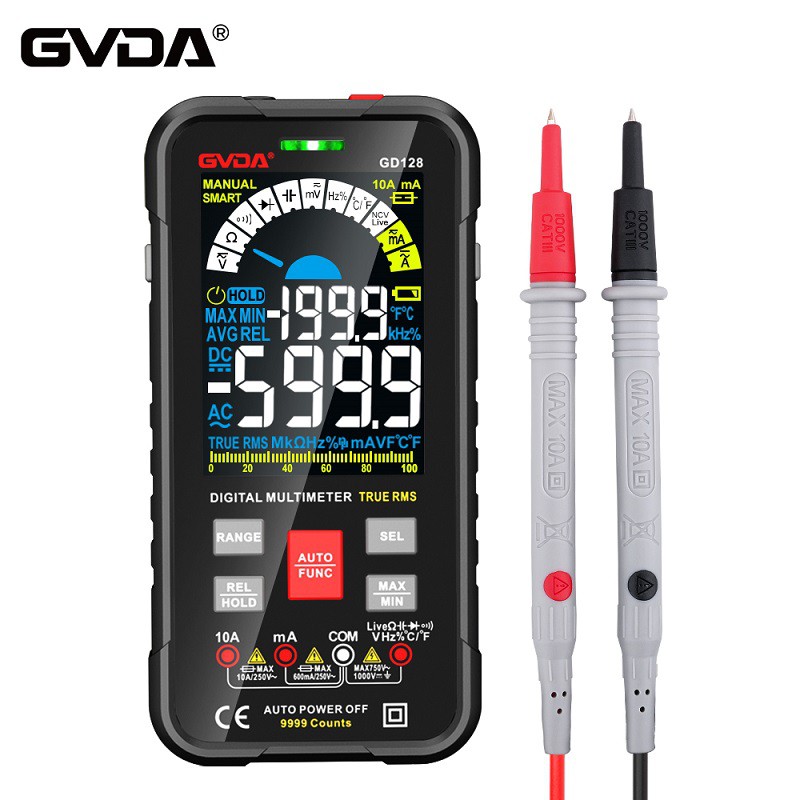
Use of a Multimeter in Home Appliance Repair
① Digital multimeter: Before measuring, first switch to the measuring gear. It should be noted that the gear marked is the range, which is the maximum value
② Mechanical multimeter: The method of measuring current and voltage is the same as the mathematical formula, but when measuring voltage, the reading needs to be multiplied by the value on the gear to obtain the measured value For example, the current gear is "X100" and the reading is 200. The measurement question is 200X100=20000 Ω=20K. The "Ω" ruler on the dial is from left to right, from large to small, while others are from left to right, from small to large
Precautions for multimeter
① To adjust the "zero point" (only available on mechanical watches), before using the watch, check that the pointer is pointing to the "zero position" on the left end. If not, slowly turn the "starting point zero position" correction screw in the center of the watch case with a small screwdriver to make the pointer point to the zero position
② When using a multimeter, it should be placed horizontally (only mechanical devices have it)
③ Before testing, it is necessary to determine the measurement content and turn the range conversion knob to the corresponding measurement gear shown to avoid burning the meter head. If the size of the measured physical quantity is unknown, the test should be started from the large range first
④ The probe should be inserted correctly into the corresponding socket
⑤ During the testing process, do not rotate the gear shift knob arbitrarily
⑥ After use, be sure to adjust the gear shift knob of the unused meter to the maximum range gear of the AC voltage
⑦ When measuring DC voltage and current, attention should be paid to the positive and negative poles of the voltage, the direction of the current, and the correct connection with the probe
Multi meter detection of open circuit fault in lighting circuit
When the lighting circuit is open, there is no voltage in the circuit, the lighting does not light up, and the electrical appliances cannot work. The reasons include: blown fuses, broken wires, loose wire ends, damaged switches, etc.
When detecting an open circuit fault in the lighting circuit with a multimeter, the resistance range of the multimeter can be used to measure the continuity of the circuit when the power is disconnected; It is also possible to use a multimeter to measure the voltage of the circuit in the AC voltage range while power is on to determine the fault point.
Lighting circuit open circuit faults can be divided into three situations: complete open circuit, partial open circuit, and individual open circuit.
(1) All open circuits
This type of malfunction mainly occurs on the main line, in distribution and metering devices, and within the range of incoming devices. Usually, the first step is to check the connection points of each joint in the above section (including the melt connection pile) in sequence, and the common fault is the disconnection of the wire end from the connection point; Secondly, check the opening and closing status of the dynamic and static contacts of each circuit switch.
(2) Partial open circuit
This type of fault mainly occurs within the range of branch lines. Generally, check the connection of each wire head first, and then check the branch switch. If the cross-sectional area of the branch wire is small, it should be considered that the core wire may break inside the insulation layer and cause a local open circuit.
(3) Individual open circuit
This type of fault is generally limited to the range of junction boxes, lamp holders, light switches, and the connecting wires between them. Usually, the connection of each joint, as well as the contact status of components such as lamp sockets, light switches, and sockets, can be checked separately (for fluorescent lamps, the connection status of each component should be checked).