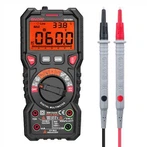
Use of the pointer multimeter function
General pointer multimeters are used to change measurement items and measurement ranges through the knob of the changeover switch. The mechanical zero knob is used to keep the pointer at rest in the left zero position. The "Ω" zero knob is used to measure the resistance so that the pointer is aligned with the right zero position to ensure that the measurement value is accurate.
The measurement range of the pointer multimeter is as follows:
-DC voltage: 5 grades - 0-6V; 0-30V; 0-150V; 0-300V; 0-600V.
-AC voltage: 5 steps - 0-6V; 0-30V; 0-150V; 0-300V; 0-600V.
-DC current: 3 levels - 0-3mA; 0-30mA; 0-300mA.
-Resistance: 5 steps-R*1; R*10; R*100; R*1K; R*10K.
The specific operation is as follows:
Measurement of resistance: - first short-circuit the meter sticks together, so that the pointer deflected to the right, and then adjust the "Ω" zero knob, so that the pointer is exactly pointing to 0. Then the two rods were contacted by the measured resistance (or the circuit) at both ends, read out the pointer on the ohm scale (the first line), and multiply it by the number of the gear label, is the resistance value of the measured resistance. The resistance value of the measured resistor is multiplied by the number of the gear label. For example, with R * 100 block resistance measurement, the pointer is pointing at 80, then the measured resistance value of 80 * 100 = 8 K. Due to the "Ω" scale on the left part of the reading is dense, difficult to see, so the measurement should be selected when the appropriate ohm gear. Make the pointer in the middle or right part of the scale, so that the reading is more clear and accurate. Each time you change gears, you should re-connect the two meter sticks short and re-adjust the pointer to the zero position in order to measure accurately.
Measurement of DC voltage: - First estimate the size of the measured voltage, then set the changeover switch to the appropriate V range, connect the positive meter stick to the "+" end of the measured voltage, and the negative meter stick to the "-" end of the measured voltage. Then according to the range of the block digital and standard DC symbol "DC-" scale (the second line) on the pointer pointed to the number, to read out the size of the measured voltage. If measured with V300 volts, you can directly read the indicated value of 0-300. Such as measuring with V30 volts, only to remove a "0" on the scale of 300 this number, seen as 30, and then 200, 100 and other numbers in turn, seen as 20, 10 can be read directly out of the pointer to indicate the value. For example, with V6 volts measuring DC voltage, the pointer points to 15, the measured voltage is 1.5 volts.
Measurement of DC current: - first estimate the size of the current to be measured, and then the conversion switch to the appropriate mA range, and then the multimeter connected in series in the circuit, as shown in the figure. At the same time, observe the scale marked with the direct current symbol "DC", such as the current range selected in the 3mA file, then, should be the surface of the scale of the number of 300, remove the two "0", as 3, and in turn 200, 100 as 2, 1, so that the current value can be read. Can read out the measured current value. For example, using DC 3mA file to measure DC current, the pointer at 100, the current is 1mA.
Measurement of AC voltage: - The method of measuring AC voltage is similar to that of measuring DC voltage, the difference is that there is no positive and negative points due to AC power, so when measuring AC, the meter stick does not need to be divided into positive and negative. The reading method is the same as that of DC voltage measurement above, except that the number should look at the position of the pointer on the scale labeled with the AC symbol "AC".