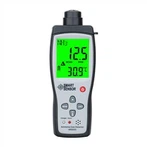
Voltage sensitivity on multimeter
Sensitivity is a technical indicator indicating how well an instrument responds to weak energy.
Since the energy that drives the deflection of the instrument measuring mechanism is taken from the current in the circuit under test, if the instrument pointer deflects to a larger extent and uses less energy, its sensitivity will be higher.
The sensitivity of a multimeter can be divided into three indicators: DC voltage sensitivity, AC voltage sensitivity and meter sensitivity. Among them, DC voltage sensitivity is the main indicator. AC voltage sensitivity is generally lower than DC voltage sensitivity due to surface circuit design factors. They are marked on the dial in ohms per volt (Ω/V).
The sensitivity of the meter indicates the full-scale current value of the meter. It also includes the internal resistance and linearity of the meter. It is the basis for calculating the meter circuit and also determines the voltage sensitivity of the entire multimeter. The internal resistance of the meter refers to the needle of the meter. The sum of the resistance values of the moving coil and the upper and lower hairsprings; linearity refers to the degree of consistency between the current intensity passing through the meter head and the deflection amplitude of the meter hand, which is used as the basis for drawing the dial scale. Here we focus on the DC voltage sensitivity of the multimeter.
When the voltmeter is measuring, it is connected in parallel with the two points being measured. Due to the internal resistance of the voltmeter, it is equivalent to connecting a resistor in parallel between the two points being measured, which reduces the total impedance between the two points being measured; and Coupled with its shunting effect on the circuit, the measured voltage value is lower than the actual value. Therefore, when making voltage measurements, the multimeter is required to have a larger internal resistance (that is, the sensitivity Ω/V number should be higher) to reduce this error.
For example, the ranges of the DC voltage range of the MF30 multimeter are 0-1-5-25-100-500V, and the dial is marked with 20000Ω/V, then the internal resistance of the 1V range is 20kΩxl=20kΩ; the internal resistance of the 5V range is 20kΩx5=100kΩ , and so on.