What Are the Advantages of Analog Multimeters and Digital Multimeters?
Analog multimeters are average-value meters. They provide intuitive and visual readout indications. (The reading value is closely related to the deflection angle of the pointer, so the reading is very intuitive.)
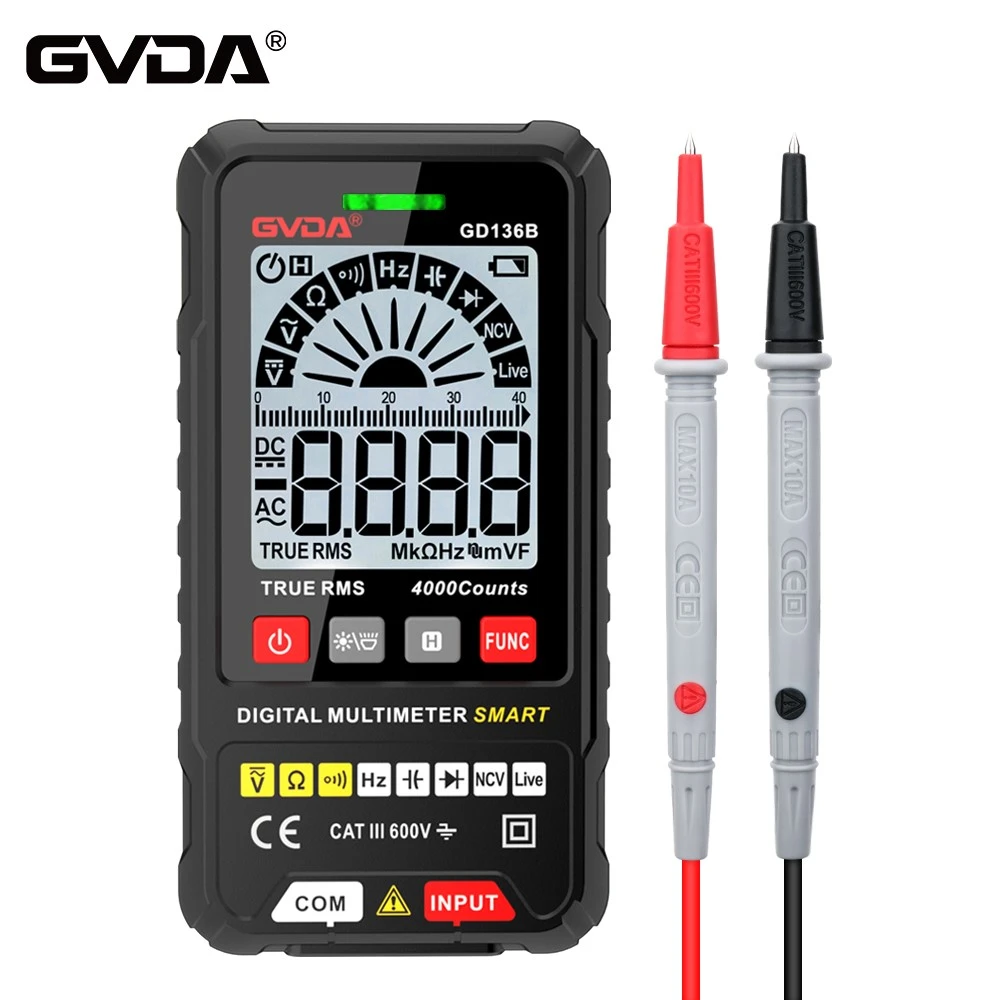
Digital multimeters are instantaneous sampling meters. They sample once every 0.3 seconds to display measurement results. Sometimes the sampled results are only very similar rather than identical, which makes reading results less convenient compared with analog multimeters.
Analog multimeters generally have no built‑in amplifiers, so their internal resistance is relatively low. For example, the MF‑10 model has a DC voltage sensitivity of 100 kΩ/V, which is already excellent. The MF‑500 model features a DC voltage sensitivity of 20 kΩ/V.
Digital multimeters employ operational amplifier circuits internally, so they can achieve very high internal resistance, often 1 MΩ or higher (which delivers higher sensitivity). This minimizes interference with the circuit under test and provides high measurement accuracy.
Due to low internal resistance and shunt/voltage‑divider circuits built mostly with discrete components, analog multimeters have non‑uniform frequency response (compared with digital multimeters). However, analog multimeters offer relatively better frequency characteristics in some respects.
Analog multimeters feature a simple internal structure, leading to lower cost, fewer functions, easy maintenance, and strong resistance to overcurrent and overvoltage.
Digital multimeters integrate various circuits for oscillation, amplification, frequency division and protection, so they support abundant functions, such as temperature measurement, frequency measurement (within a low range), capacitance measurement, inductance measurement, and even signal generation.
Since integrated circuits are widely used in their internal structure, digital multimeters have poor overload tolerance. (Some modern models support auto‑ranging and automatic protection, yet they are more complicated to operate.) They are generally difficult to repair once damaged.
Digital multimeters have a low output voltage (usually no more than 1 V), which brings inconvenience for testing components with special voltage characteristics (such as silicon controlled rectifiers and light‑emitting diodes).
Analog multimeters provide a higher output voltage (such as 10.5 V and 12 V).