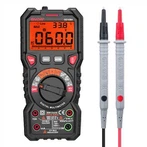
Five Methods for Digital Multimeter Troubleshooting
Troubleshooting a digital multimeter generally starts with the power supply. For instance, after powering on, if the LCD shows no reading, first check whether the voltage of the 9V stacked battery is too low and whether the battery lead is disconnected. Locating faults follows the rule of "checking the inside before the outside, checking simple problems before difficult ones". The troubleshooting of digital multimeters can generally be carried out by the following methods.
Five General Methods for Troubleshooting Digital Multimeters
① Performing visual and tactile inspection: Feeling the temperature rise of batteries, resistors, transistors and integrated circuits by hand. If a newly installed battery gets hot, it may indicate a short circuit in the circuit. Besides, observing the circuit for broken wires, cold solder joints, mechanical damage and other defects.
② Measuring operating voltages at all stages: Testing the working voltage of each point and comparing it with the normal value. Ensuring the accuracy of the reference voltage first. It is best to use another digital multimeter of the same or similar model for measurement and comparison.
③ Conducting waveform analysis: Using an oscilloscope to observe the voltage waveform, amplitude, period (frequency) and other parameters at key points of the circuit. For example, checking whether the clock oscillator starts oscillating and whether its oscillation frequency is 40 kHz. If the oscillator has no output, the internal inverter inside the TSC7106 may be damaged, or external components may be open-circuited. The waveform at pin 21 of the TSC7106 should be a 50 Hz square wave; otherwise, the internal 200-frequency divider may be faulty.
④ Measuring component parameters: Performing in-circuit or out-of-circuit measurement for components within the faulty area and analyzing the measured values. When measuring resistors in-circuit, taking the influence of parallel components into consideration.
⑤ Eliminating intermittent faults: Intermittent faults refer to failures that occur sporadically, making the meter work erratically. Such faults are relatively complicated. Common causes include cold solder joints, loose connections, loose connectors, poor contact of the rotary switch, unstable component performance, nearly broken leads, etc. External factors can also trigger these faults, such as excessive ambient temperature, high humidity or nearby intermittent strong interference signals.