What Are the Differences Between Analog Multimeters and Digital Multimeters?
Analog multimeters are the oldest type of multimeter. They feature a pointer that rotates along a graduated scale, though readings can be difficult to take. Their advantages are low cost and high sensitivity. Analog multimeters are more sensitive than digital multimeters and can even detect tiny variations in readings.
An analog multimeter consists of a coil placed between two permanent magnets, with a pointer mounted on top of the coil. When current flows through the coil, the coil generates a magnetic field that interacts with the field of the permanent magnets, causing the coil to rotate. As the coil turns, the pointer moves along the scale. The rotation angle of the coil depends on the amount of current passing through it. For this reason, analog multimeters are also known as galvanometers. They have very low resistance and are therefore more sensitive than digital multimeters. Care must be taken to avoid full-scale deflection (FSD). If the current exceeds the deflection range of the coil, the coil may burn out and the instrument will be damaged.
Digital Multimeters
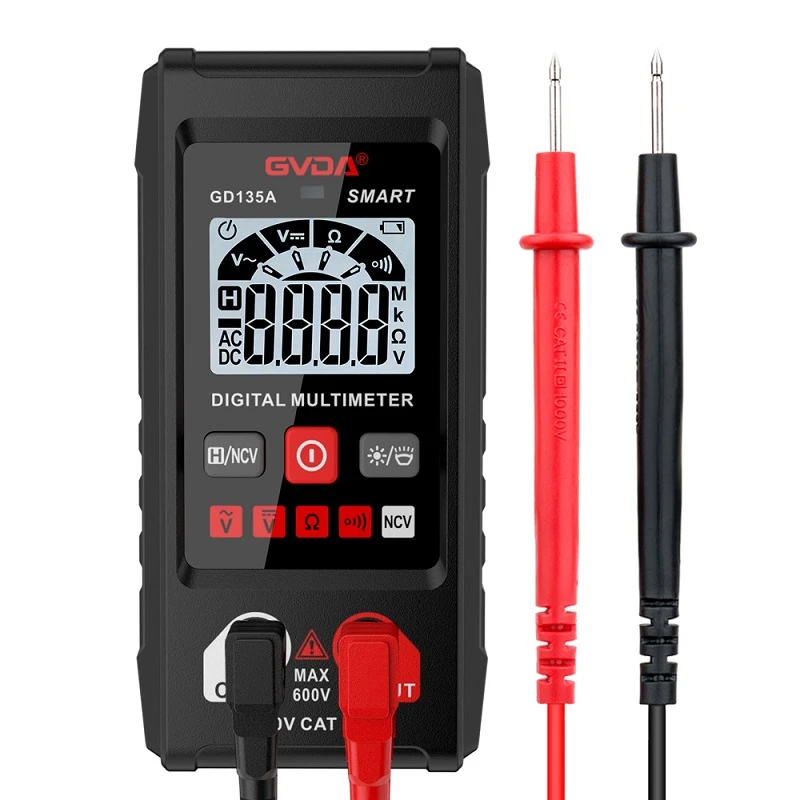
A digital multimeter is an instrument that measures various parameters and displays them on an LCD screen. Unlike analog multimeters, digital multimeters display results through digital computation, making measurement values easier to read. On the other hand, analog multimeters show readings without any computation, giving them a fast response time.
A digital multimeter is equipped with an LCD, a rotary selector dial and multiple terminals. The dial contains internal circuits connected via concentric rings. The rotary dial switch activates the corresponding circuit for a specific measurement. A built-in microprocessor calculates the readings. However, the input voltage or current is in analog form, so an ADC (Analog-to-Digital Converter) is included to convert the signals and present the results on the LCD. Unlike the pointer scale of analog meters, the LCD makes measurement values easy to read. In addition, digital multimeters provide overload protection when measurements exceed the selected range.