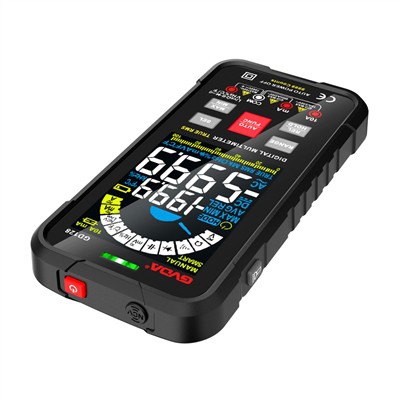
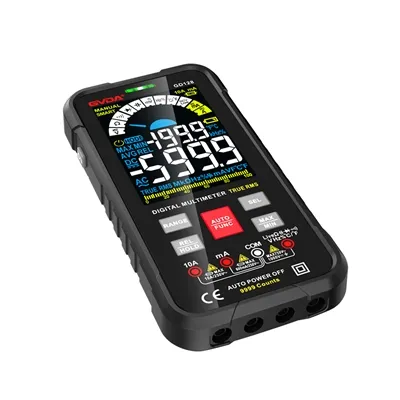
What are the factors that affect the measurement accuracy when the coating thickness meter measures the dry film thickness?
1. Thickness of covering layer
The uncertainty of measurement is an inherent characteristic of eddy current thickness measurement methods. For thinner cover layers (e.g. less than 25 μ m), the measurement uncertainty is a constant value, independent of the thickness of the cover layer, and the uncertainty of each measurement is at least 0.5 μ m. For the instrument, this uncertainty ranges from 0.5 μ m to 1 μ m. For thicker cover layers with a thickness greater than 25 μ m, a certain ratio of thickness is required. For this instrument, the uncertainty is 2% of the thickness of the cover layer.
For cover layers with a thickness of less than or equal to 5 μ m, the thickness value should be taken as the average of several measurements.
For cover layers with a thickness less than 3 μ m, the film thickness value cannot be accurately measured.
2. Conductivity of the base metal
The measurement value of eddy current thickness measurement method will be affected by the conductivity of the base metal. The conductivity of metals is related to their material composition and heat treatment. The influence of conductivity on measurement varies significantly depending on the manufacturer and model of the instrument. The measurement of this instrument is minimally affected by the conductivity of the base metal.
3. Thickness of the base metal
Each instrument has a critical thickness value for the base metal, beyond which the measured value will not be affected by an increase in the base metal thickness. This critical thickness value depends on the operating frequency of the instrument probe system and the conductivity of the base metal. The critical thickness value of this instrument is approximately 0.3~0.4 mm.
It is unreliable to stack samples with a base metal thickness below the critical level with uncoated materials of the same material and thickness.
4. Edge effect
The eddy current thickness gauge is sensitive to surface discontinuities of the specimen. Measurements that are too close to the edge of the sample are unreliable. If it is necessary to measure on a small area sample or narrow strip sample, an uncoated material with the same shape can be used as the substrate to recalibrate the instrument. For this instrument, when the measurement area is less than 150 mm2 or the sample width is less than 12 mm, the instrument should be recalibrated on the corresponding uncoated material.
5. Curvature
The change in curvature of the sample will affect the measured value. The smaller the curvature of the sample, the greater the impact on the measured value. For this instrument, when measuring samples with a diameter less than 50 mm, the instrument should be recalibrated on uncoated materials of the same diameter.
6. Surface roughness
The surface roughness of the base metal and cover layer has an impact on the measured values. Taking the average of multiple measurements at different locations can reduce this impact. If the surface of the base metal is rough, the instrument zero point should be calibrated at multiple positions on the corresponding metal material before coating.