What are the operating rules for clamp ammeters? How to operate an ammeter
An ammeter refers to an instrument used to measure the current in AC and DC circuits. In the circuit diagram, the symbol of the ammeter is "Circle A". The current value is in standard units of "ampere" or "A".
Operation and use of clamp ammeters
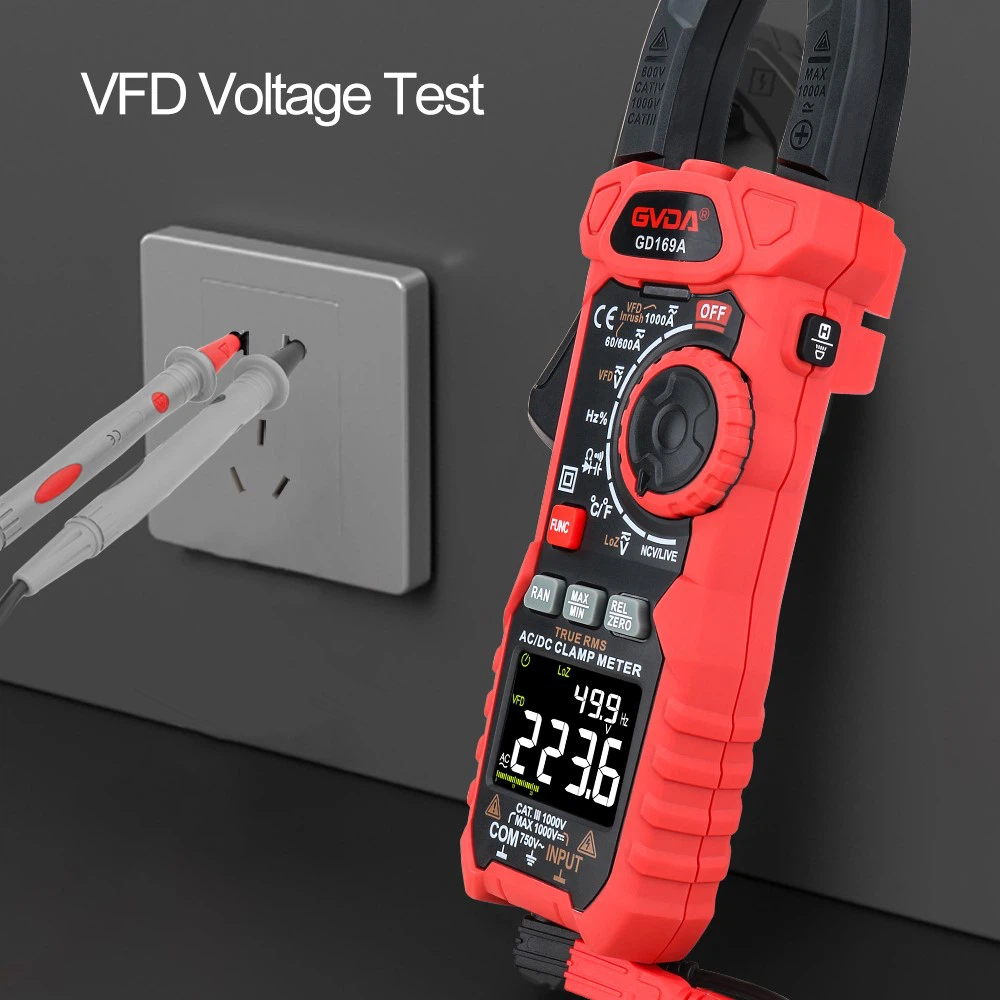
A clamp type ammeter is a combination of a current transformer and an ammeter. The iron core of the current transformer can be opened when the wrench is tightened; The wire through which the measured current passes can pass through the open gap of the iron core without cutting it off. When the wrench is released, the iron core closes.
When using a clamp type ammeter to detect current, it is necessary to clip in one of the tested wires (wires). Clipping in two parallel wires cannot detect current. In addition, when using the center (iron core) of the clamp type ammeter for detection, the detection error is small. When checking the power consumption of household appliances, using a wire separator is more convenient. Some wire separators can amplify the detection current by 10 times, Therefore, currents below 1A can be amplified before detection. When using a DC clamp ammeter to detect DC current (DCA), if the current flow is opposite, it displays a negative number. This function can be used to detect whether the car's battery is in a charging or discharging state
True RMS detection
The clamp type ammeter with an average value method detects the average value of a sine wave through AC detection, and displays the value after amplification by 1.11 times (sine wave AC) as the effective value. Waveforms and distorted waves with different waveform rates other than sine waves are also displayed after amplification by 1.11 times, resulting in indication errors. Therefore, when detecting waveforms and distorted waves other than sine waves, please choose a clamp type ammeter that can directly test the true effective value
Leakage detection
Leakage detection is different from normal current detection, where two (single-phase 2-wire type) or three (single-phase 3-wire type, three-phase 3-wire type) need to be clamped together. It is also possible to clamp the grounding wire for testing. The insulation management method for detecting leakage current on low-voltage circuits has become the primary judgment method. Since its confirmation by the 1997 revision of electrical equipment technical standards, leakage current clamp meters have gradually been used for testing in buildings and factories that cannot be powered off
How to use an ammeter
1. Table connection
The ammeter must be connected in series in the circuit to be tested, so that the current flows in from the "+" terminal of the ammeter and out from the "-" terminal. When using an ammeter, its two terminals must not be directly connected to the two poles of the power supply, otherwise the ammeter will burn out due to excessive current.
2. Select the range of the table
The ammeter has three terminals, as shown in the above figure. If the ammeter is connected to the "+" and "0.6" terminals, with a range of 0.6A, read the set of values on and below the dial; If connected to the "+" and "3" terminals, with a range of 3A, read the set of values on the dial. Before the experiment, if you don't know how to connect it, you can estimate the current value in the circuit first. If the estimated current is less than 0.6A, the range should be selected. If the estimated current is greater than 0.6A but less than 3A, the range should be selected. If it cannot be estimated, a trial contact method can be used (fixing a terminal and quickly touching the terminal of the maximum range with another wire end of the circuit), and then selecting an appropriate range based on the angle of deflection of the ammeter pointer.
3. Trial connection circuit
After connecting the physical diagram according to the circuit diagram, a trial connection must be carried out. During the trial connection, carefully observe the deflection of the ammeter pointer. If the pointer does not deflect, it indicates that there is a circuit break somewhere in the circuit; If the pointer deflects in the opposite direction, it indicates that the positive and negative terminals of the meter are connected in the opposite direction; If the deflection angle of the pointer is too large, it indicates that the range is selected too small; If the deflection angle of the pointer is too small, it indicates that the range is too large. Then, based on the observed situation during the trial connection, make corresponding adjustments before conducting relevant experiments.