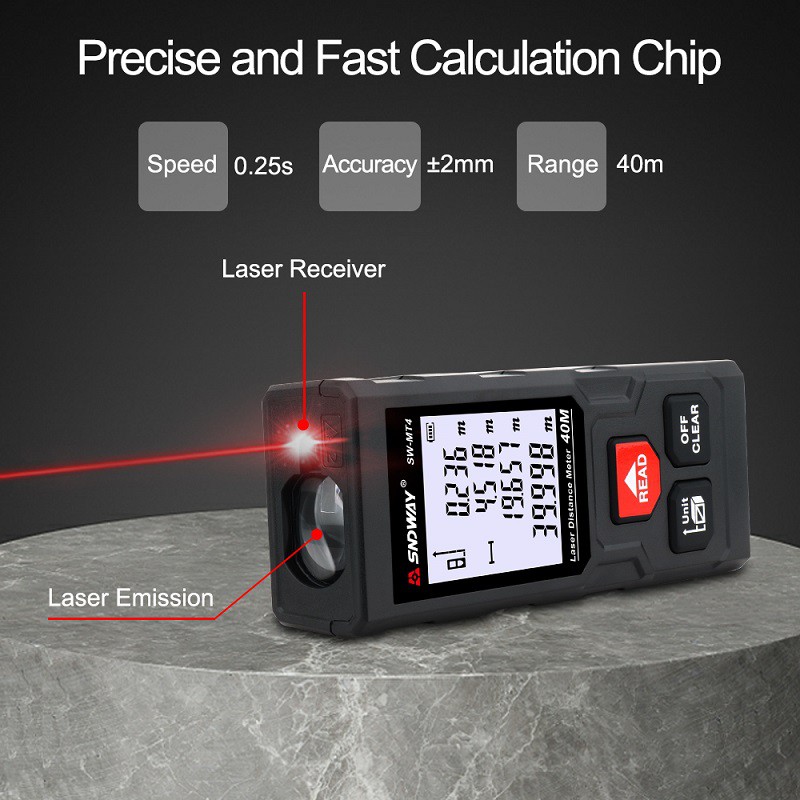
What are the principles of infrared ranging and laser ranging?
The ranging principle can be generally summarized as measuring the round‑trip travel time of light to the target. The distance D is then calculated using the speed of light c=299792458 m/s and the atmospheric refractive index n. Since direct time measurement is technically difficult, most instruments measure the phase of continuous waves instead, known as phase‑shift rangefinders. Pulse‑type rangefinders also exist, with the WILD DI‑3000 as a typical example. It should be noted that phase detection does not target the phase of infrared or laser light itself, but the phase of the modulated signal carried by the infrared or laser beam. Handheld laser rangefinders widely used for building and housing surveys operate on this identical principle.
Must the surface of the measured object be perpendicular to the light beam?
High‑precision ranging usually requires a fully reflective prism. By contrast, rangefinders for indoor housing measurement rely on direct reflection from smooth wall surfaces. This is feasible mainly due to short measuring distances and sufficiently strong reflected signals. Accordingly, perpendicular incidence is generally required; otherwise, the return signal will be too weak to obtain accurate distance data.
Is ranging feasible on diffuse reflective surfaces?In most cases, yes. In practical engineering, thin plastic sheets are commonly used as auxiliary reflective surfaces to compensate for severe diffuse reflection.
Ultrasonic ranging offers relatively low accuracy and is rarely adopted in modern applications.