What are the technical parameters and measurement methods of digital multimeters?
1. Resolution, word count, and bit count
Resolution refers to the ability of a multimeter to distinguish small signals during measurement. Knowing the resolution of a multimeter can determine whether it can observe small changes in the measured signal. For example, if the resolution of a digital multimeter on a 4V range is 1mV, it means that it can observe a change of 1mV (1/1000V) when reading 1V.
If you must measure a minimum length of 1/4 inch (or 1 millimeter), then you will not purchase a ruler with a minimum scale of 1 inch (or 1 centimeter). If the normal temperature is 98.6 degrees Fahrenheit, then a thermometer that can only measure whole degrees is of little use. You need a thermometer with a resolution of 0.1 degrees.
The words "bit" and "word" are used to describe the resolution of a multimeter. They can be grouped according to the number of words or digits displayed on a digital multimeter.
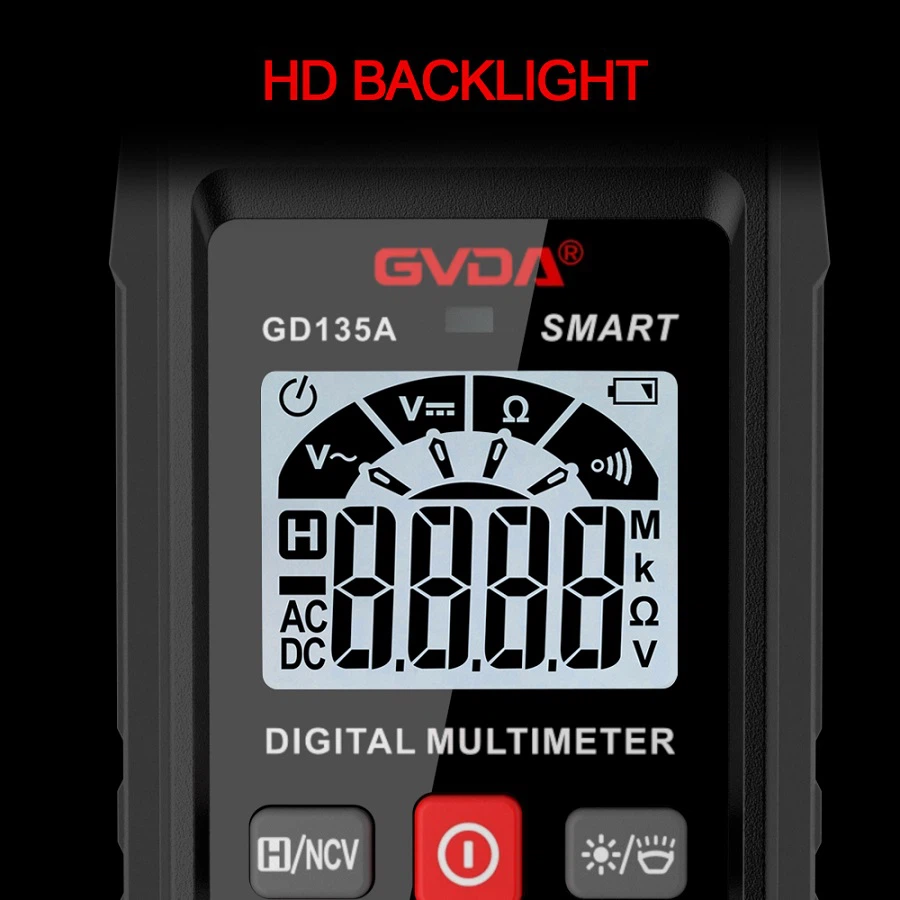
A 3 1/2 multimeter can display three whole digits (0 to 9) and one "half digit" (only one "1" is displayed or left blank). A 3 1/2 digit multimeter has a high display resolution of 1999 words. A display resolution of up to 19999 words can be achieved on a 4/4-digit multimeter. Compared to 'bit', using 'character' can more accurately describe the resolution of a multimeter. The resolution of a current 3 and a half bit multimeter may be as high as 3200, 4000, or 6000 words.
For certain measurements, a 3200 word multimeter can provide better resolution. For example, if you want to measure a voltage of 200V or higher, a 1999 word multimeter cannot measure 0.1V. A 32 million meter can display 0.1V when measuring voltages up to 320V. Before exceeding a voltage of 320V, this resolution is the same as that of a more expensive 20000 word multimeter.
1. Resolution, word count, and bit count
Resolution refers to the ability of a multimeter to distinguish small signals during measurement. Knowing the resolution of a multimeter can determine whether it can observe small changes in the measured signal. For example, if the resolution of a digital multimeter on a 4V range is 1mV, it means that it can observe a change of 1mV (1/1000V) when reading 1V.
If you must measure a minimum length of 1/4 inch (or 1 millimeter), then you will not purchase a ruler with a minimum scale of 1 inch (or 1 centimeter). If the normal temperature is 98.6 degrees Fahrenheit, then a thermometer that can only measure whole degrees is of little use. You need a thermometer with a resolution of 0.1 degrees.
The words "bit" and "word" are used to describe the resolution of a multimeter. They can be grouped according to the number of words or digits displayed on a digital multimeter.
A 3 1/2 multimeter can display three whole digits (0 to 9) and one "half digit" (only one "1" is displayed or left blank). A 3 1/2 digit multimeter has a high display resolution of 1999 words. A display resolution of up to 19999 words can be achieved on a 4/4-digit multimeter. Compared to 'bit', using 'character' can more accurately describe the resolution of a multimeter. The resolution of a current 3 and a half bit multimeter may be as high as 3200, 4000, or 6000 words.
For certain measurements, a 3200 word multimeter can provide better resolution. For example, if you want to measure a voltage of 200V or higher, a 1999 word multimeter cannot measure 0.1V. A 32 million meter can display 0.1V when measuring voltages up to 320V. Before exceeding a voltage of 320V, this resolution is the same as that of a more expensive 20000 word multimeter.
2. Accuracy
Accuracy is the maximum allowable error that occurs under specific operating conditions. In other words, accuracy refers to the degree to which the measured value displayed by a digital multimeter is close to the actual value of the measured signal.
The accuracy of a digital multimeter is usually expressed as a percentage of the reading. The accuracy is represented by 1% of the reading. If the displayed reading is 100V, the actual voltage value may be any value between 99V and 101V.
The technical parameters may also include a range of bits added to the basic accuracy parameters. This range represents the number of words in which the rightmost digit of the displayed value may change. In this way, the accuracy in the above example can be expressed as "± (1%+2)". Therefore, if the displayed reading is 100V, the actual voltage value will be between 98.8V and 101.2V.