What are the types of soldering irons? Four classifications of soldering irons
Soldering irons are divided into: 1. External heating soldering iron 2. Internal heating soldering iron 3. Constant temperature soldering iron 4. Tin-absorbing soldering iron.
1. External heating electric soldering iron
It consists of soldering iron tip, soldering iron core, shell, wooden handle, power lead, plug and other parts.
Because the soldering iron head is installed inside the soldering iron core, it is called an external heating type electric soldering iron. The soldering iron core is the key component of the electric soldering iron. It is formed by winding the heating wire in parallel on a hollow porcelain tube. The mica sheet in the middle is insulated, and two wires are drawn out to connect with the 220V AC power supply. There are many specifications of external heating electric soldering irons, commonly used are 25W, 45W, 75W, 100W, etc. The higher the power, the higher the temperature of the soldering iron tip.
2. Internal heating electric soldering iron
It consists of a handle, connecting rod, spring clip, soldering iron core, and soldering iron tip. Because the soldering iron core is installed inside the soldering iron head, it is called an internal heating type electric soldering iron. The internal heat type electric soldering iron heats up quickly, has high heating efficiency, and its volume is small, and the price is cheap. The rear end of the internal heating type soldering iron is hollow, used to be sleeved on the connecting rod, and fixed with a spring clip. It is more convenient to replace the soldering iron tip. When the soldering iron tip needs to be replaced, the spring clip must be withdrawn first, and at the same time, use the pliers to clamp the front end of the soldering iron tip and pull it out slowly. Remember not to use too much force to avoid damage to the connecting rod.
Generally, an internal heating electric soldering iron of about 35W is used for electronic production. Of course, there is a 50W external heating electric soldering iron to be prepared. Due to its high thermal efficiency, a 20W internal heating soldering iron is equivalent to a 40W external heating soldering iron. Common internal heat and lead-free long-life internal thermoelectric soldering irons on the market have powers of 20W, 25W, 35W, 50W, etc., of which 35W and 50W are the most commonly used. Thermostatic Soldering Iron
Because the constant temperature electric soldering iron head is equipped with a temperature controller with a magnet, the temperature control is realized by controlling the power-on time, that is, when the electric soldering iron is energized, the temperature of the soldering iron rises. When the predetermined temperature is reached, the strong magnetic sensor reaches Curie point and the magnetism disappears, so that the magnetic core contact is disconnected, and then the power supply to the electric soldering iron is stopped; when the temperature is lower than the Curie point of the strong magnet sensor, the strong magnet returns to magnetism, and the magnetic core switch is attracted The permanent magnet in the circuit makes the contacts of the control switch connected and continues to supply power to the electric soldering iron. This cycle goes on and on, and the purpose of temperature control is achieved.
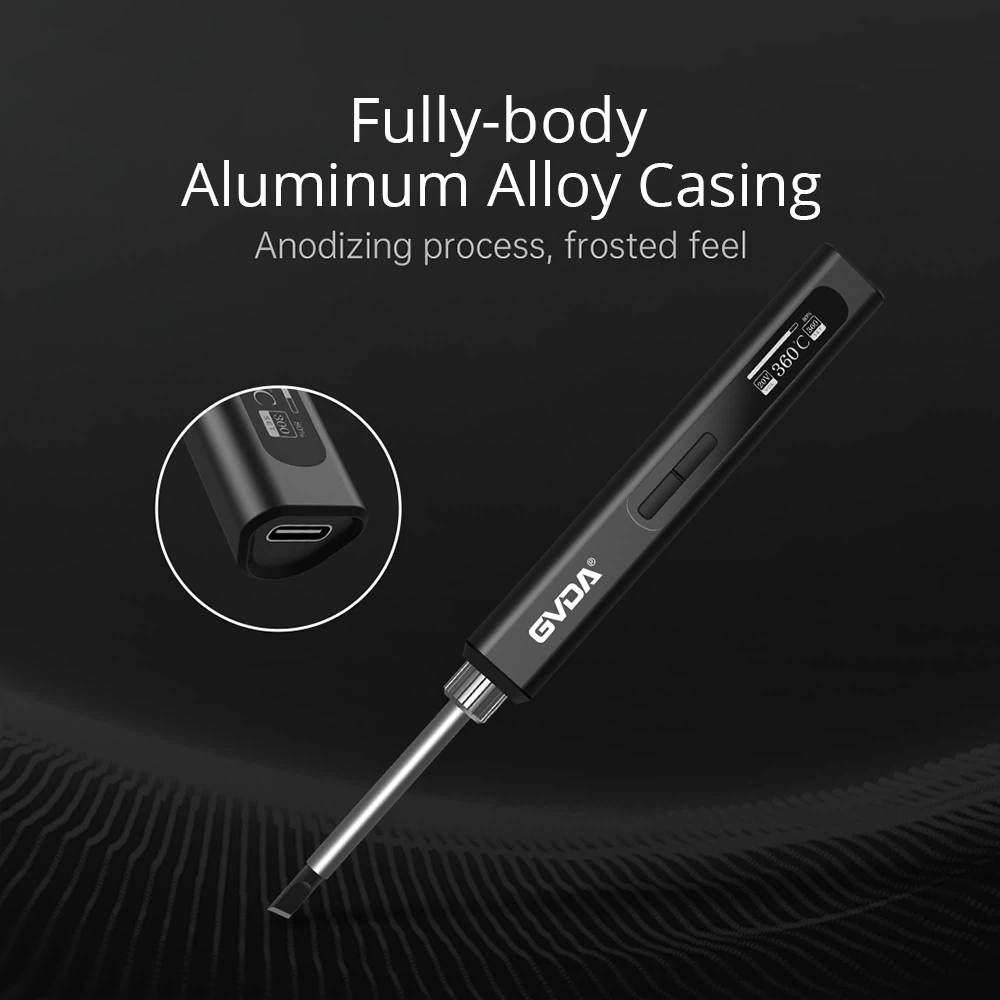
There are many types of constant temperature electric soldering irons, and the soldering iron core generally uses PTC components. This type of soldering iron head can not only keep a constant temperature, but also be anti-static, anti-inductive, and can directly solder CMOS devices. The high-grade constant temperature electric soldering iron has a digital display (referred to as digital display) device for the temperature of the soldering iron tip on its additional control device, and the display temperature can reach up to 400°C. The soldering iron head has a temperature sensor, and the temperature during soldering can be changed manually on the controller. If the constant temperature point is changed, the tip of the soldering iron can quickly reach the new set temperature.
The cordless electric soldering iron is a new type of constant temperature welding tool, which is composed of a cordless electric soldering iron unit and an infrared constant temperature soldering station unit, which can realize the wireless transmission of the conversion of 220V power supply into heat energy.
There is a temperature adjustment knob in the soldering iron unit assembly, which can be continuously adjusted from 160 to 400°C, and has a high and low temperature grid indication. In addition, an automatic constant temperature electronic circuit is also designed, which can automatically maintain the temperature according to the operating temperature set by the user, and the error range is 3°C.
3. Temperature-adjustable electric soldering iron
The temperature-adjustable electric soldering iron is equipped with a power controller, which can change the input power of the power supply during use, and the adjustable temperature range is 100~400°C. The maximum power of the temperature-adjustable electric soldering iron is 60W, and the soldering iron tip used is a copper-plated iron tip (commonly known as a longevity tip).
4. Dual-temperature soldering iron
The dual-temperature soldering iron has a pistol structure, and a power conversion switch is attached to the handle of the soldering iron. There are two switches: one is 20W; the other is 80W. As long as the position of the switch is changed, the heating value of the electric soldering iron can be changed. Suction soldering iron
Tin-absorbing soldering iron is a desoldering tool that integrates a piston-type tin absorber and an electric soldering iron. It has the characteristics of convenient use, flexibility and wide application range. The disadvantage of this soldering iron is that it can only desolder one solder joint at a time. Tin-absorbing electric soldering iron has its own power supply, which is suitable for disassembling the entire integrated circuit, and the speed requirement is not high. The materials used for the tin nozzle, heat pipe, and sealing ring determine the durability of the soldering iron tip.