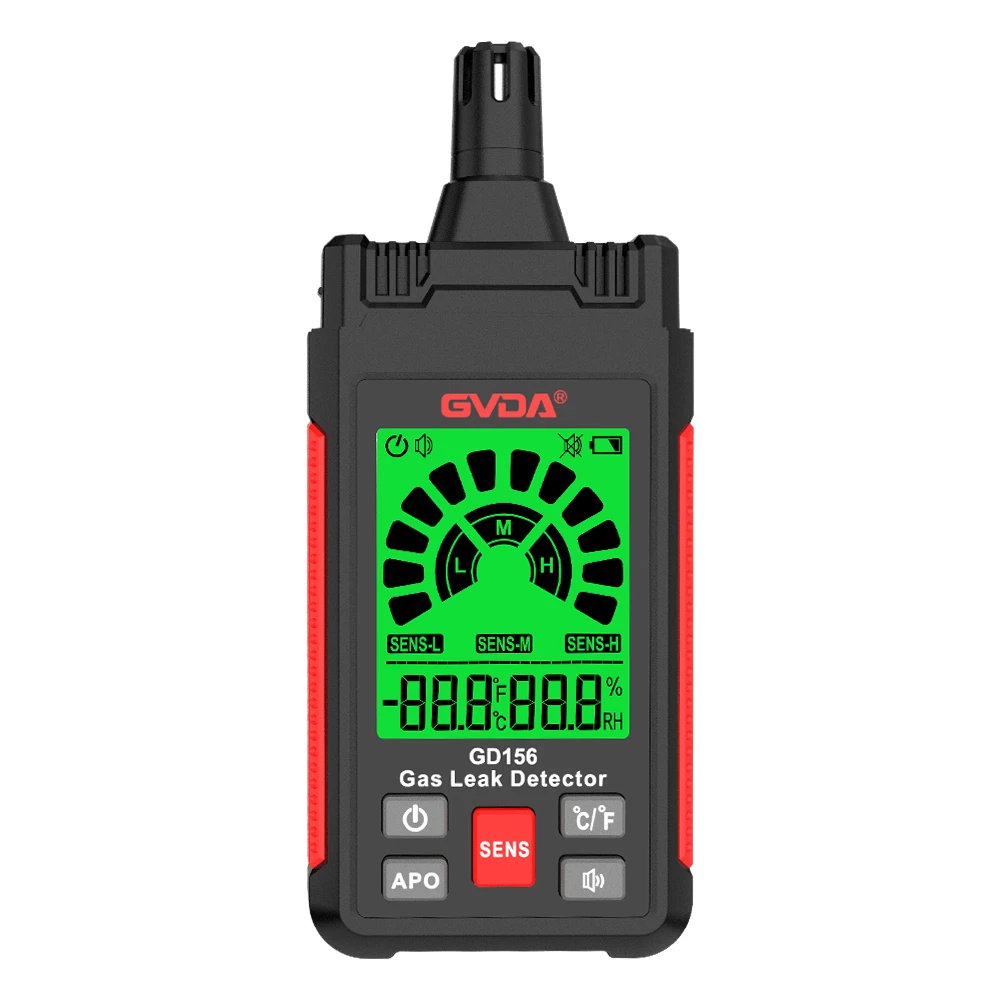
What does the measuring range of 0–100% LEL on a flammable gas detector mean?
LEL stands for Lower Explosive Limit. It refers to the minimum concentration at which a flammable gas can explode when ignited by an open flame in air, abbreviated as %LEL. The correct full English term is Lower Explosive Limit.
The maximum concentration at which a flammable gas can explode in air under ignition is defined as the Upper Explosive Limit, abbreviated as %UEL, with the full name Upper Explosive Limit.
Definition of Lower Explosive Limit
A flammable gas poses no explosion hazard when its concentration is too low or too high. Combustion or explosion only occurs when it mixes with air, or more precisely, forms a mixture with oxygen at a specific volume ratio. Combustion is a violent oxidation reaction accompanied by light and heat, which requires three essential conditions: a. Combustible material (fuel gas); b. Oxidizing agent (oxygen); c. Ignition source (thermal energy).
Combustion of flammable gases falls into two categories:
Diffusion combustion: Volatilized, ejected or leaked flammable gas from equipment mixes with an ignition source and undergoes combustion.
Premixed combustion: The gas fully blends with air before ignition. This reaction is fierce and rapid, often generating tremendous pressure and loud noise, which is also referred to as an explosion. There is no rigid boundary between combustion and explosion.
Authoritative institutions and experts have conducted combustion and explosion characteristic analysis for all known flammable gases and formulated their explosion limits, divided into Upper Explosive Limit (UEL) and Lower Explosive Limit (LEL). Below the LEL, the proportion of combustible gas in the mixture is insufficient to sustain combustion or explosion. Above the UEL, the oxygen content in the mixture becomes inadequate to trigger a reaction. In addition, the combustion and explosion of flammable gases are also affected by gas pressure, ambient temperature, ignition energy and other parameters. Explosion limits are generally expressed in volume percentage.
Explosion limit is the collective term for LEL and UEL. A flammable gas can only explode when its concentration in air falls between the lower and upper explosive limits. No explosion will occur if the concentration is below LEL or above UEL. For safety monitoring, the alarm threshold is usually set below 25% LEL.
Fixed flammable gas detectors are commonly configured with two alarm setpoints (depending on the model of the alarm control host): 10% LEL for the first-level alarm, and 25% LEL for the second-level alarm.