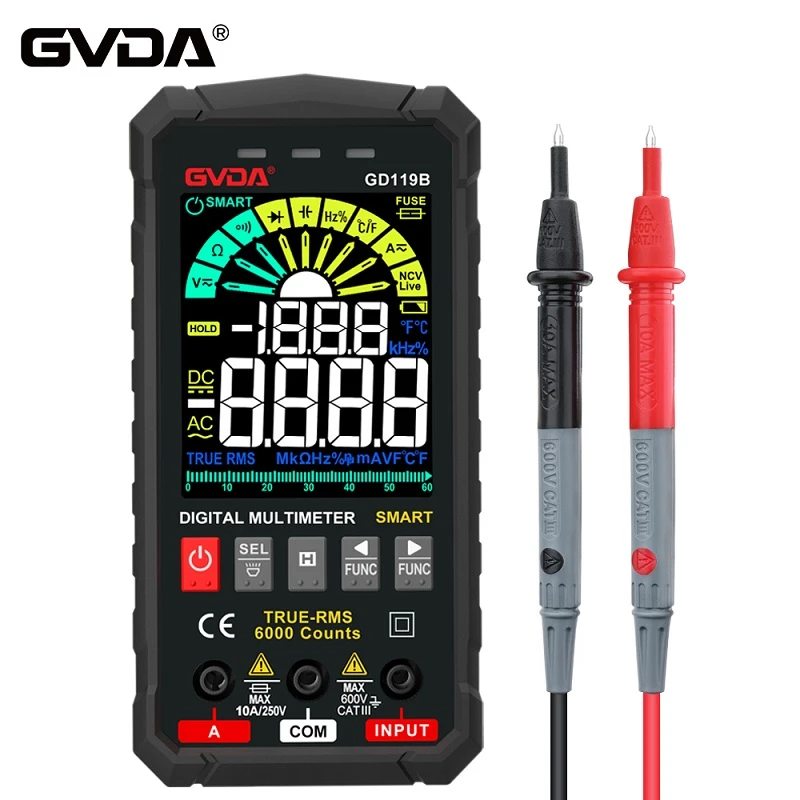
What is the effective value and true effective value of the multimeter
The magnitude of alternating current changes with time, the instantaneous value (a certain moment) varies between zero and positive and negative peak values, and the maximum value is only a momentary value, which cannot reflect the workability of alternating current.
Then the concept of effective value is introduced, which is defined as:
Effective value: It is defined by heat generation (power). A certain alternating current passes through a resistor to generate heat and another direct current passes through the resistor. If the heat generated in the same time is equal, then the direct current voltage value is the voltage of this alternating current. valid value.
True RMS: The definition of RMS is defined by heating, but it is difficult to measure the RMS voltage in this way in measuring instruments, so most voltage measuring instruments, such as multimeters measure voltage, its measurement The method is not measured according to the "heat" defined by the effective value. One of the multimeters uses the sine wave as a reference, and the effective value is obtained by the relationship between the peak value of the sine wave and the effective value twice the root sign (or through the average value), the effective value obtained by this method is only correct for the AC voltage of the sinusoidal waveform, and there will be deviations for other shapes of the waveform. Another type of multimeter voltage value is obtained by the square of the effective value of the DC component, the fundamental wave, and each higher harmonic. This value is similar to the definition of the effective value, and there is no requirement for the shape of the waveform. The sine wave is different from the effective value instrument, which is called "true effective value" in the measuring instrument.
Root mean square value: Another name for effective value (should be true effective value on a measuring instrument).
A valid value for a multimeter typically refers to one of three things:
1. Calibration average value method, the calibration average value is also called the corrected average value, or the rectified average value calibrated to the effective value. The principle is to convert the AC signal into a DC signal through the rectification and integration circuit, and then according to the characteristics of the sine wave, Multiplied by a coefficient, for a sine wave, after multiplying by this coefficient, the result is equal to the effective value of the sine wave. Therefore, this method is limited to sine wave testing.
2. The peak detection method obtains the peak value of the AC signal through the peak detection circuit, and then multiplies it by a coefficient according to the characteristics of the sine wave. For the sine wave, after multiplying the coefficient, the result is equal to the effective value of the sine wave. Therefore, this method is limited to sine wave testing.
3. True RMS method, using a true RMS circuit to convert the AC signal into a DC signal and then measure. This method is suitable for the true RMS test of arbitrary waveforms.
Most multimeters use the first two methods. And there is a big limit to the frequency of the signal.
For alternating current, its voltage is a changing waveform. Usually we describe its voltage value as its effective value. As we call 220V power supply, its peak voltage is more than 310 volts, and its peak value is twice the peak value. It is more than six hundred volts.
The effective values of the electromotive force, voltage, and current of the sinusoidal alternating current are represented by E, U, and I, respectively. The magnitude of the electromotive force, voltage, and current of the so-called alternating current is its effective value. The rated value marked on the AC electrical equipment and the value indicated by the AC meter are also effective values.
Both theory and experiment have shown that the relationship between the effective value and maximum value of sinusoidal alternating current is: E=E/V Voltage and current also have instantaneous value, maximum value and effective value. Generally, the instantaneous value is represented by lowercase letters (such as u, i, etc.), and the maximum value is represented by capital letters with a subscript m (such as Um, Im). Valid values are denoted by capital letters (U, I). The relationship between the maximum value and the effective value is: U=U/V, I=I/V
To put it simply, the true effective value multimeter is more expensive than the effective value multimeter. The effective value multimeter can only measure sinusoidal alternating current, and it is not accurate to measure non-sinusoidal alternating current, but it is enough for normal use.