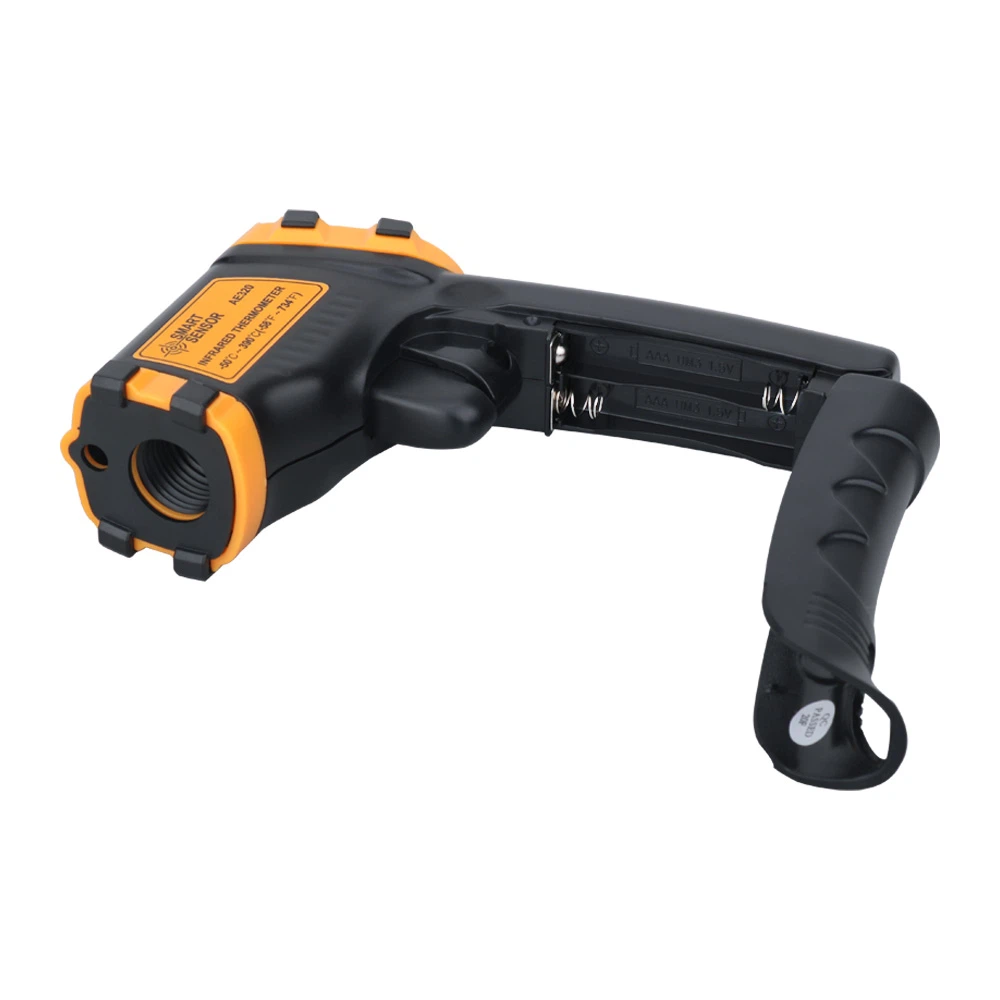
What is the error of an infrared thermometer?
Infrared thermometer is generally about 0.2.
Currently on the market for sale of infrared thermometers are many should be the need to prevent SARS by the industrial thermometer modified by the ambient temperature at the time of the impact is relatively large, measured body temperature and the actual temperature error.
Factors affecting the error of infrared thermometer
1, the radiation rate
Radiation rate is an object relative to the size of the black body radiation capacity of physical quantities, it is in addition to the shape of the material with the object, surface roughness, convexity, etc., but also with the direction of the test. It is more sensitive to orientation if the object has a polished surface. The emissivity of different substances is different, infrared thermometer instrument from the object to receive the size of the radiant energy is proportional to its emissivity.
(1) the radiation rate of the set according to Kirchhoff's theorem: the object surface of the hemispherical monochromatic emissivity (ε) is equal to its hemispherical monochromatic absorptivity (α), ε = α. In thermal equilibrium conditions, the object's radiant power is equal to its absorbed power, i.e., absorptivity (α), reflectance (ρ), transmittance (γ) sum of 1, i.e., α + ρ + γ = 1. For the opaque (or with a certain thickness) of the object Transmittance can be seen γ = 0, only radiation and reflection (α + ρ = 1), when the object's radiance is higher, the smaller the reflectivity, the background and reflection of the impact will be smaller, the higher the accuracy of the test; conversely, the higher the background temperature or reflectivity, the greater the impact on the test. It can be seen that in the actual testing process must pay attention to the different objects and the thermometer corresponding to the radiation rate, the radiation rate should be set as accurately as possible, in order to reduce the error of the measured temperature.
(2) Test angle
Radiation rate and test direction, the larger the test angle, the greater the test error, in the use of infrared temperature measurement, this point is easily overlooked. Generally speaking, the best test angle within 30 ° C, generally should not be greater than 45 ° C. If you have to be greater than 45 ° C for the test, you can appropriately lower the emissivity for correction. If the temperature measurement data of two identical objects to be judged and analysed, then the test angle must be the same during the test, so that it is more comparable.
2, distance coefficient
Distance coefficient (K = S: D) is the pyrometer to the target distance S and the diameter of the temperature measurement target D ratio, which has a great impact on the accuracy of the infrared thermometer, the larger the K value, the higher the resolution. Therefore, if the pyrometer must be installed away from the target due to environmental conditions, and to measure small targets, it should choose a high optical resolution pyrometer to reduce the measurement error. In practice, many people ignore the optical resolution of the pyrometer. Regardless of the size of the measured target point diameter D, open the laser beam aligned with the measurement target on the test. In fact, they ignore the requirements of the pyrometer's S: D value, so that the measured temperature will have a certain degree of error.
3, the target size
The measured object and the pyrometer field of view determines the accuracy of the instrument measurement. The use of infrared pyrometer instrument temperature measurement, generally can only determine the average value of the determined area on the surface of the target to be measured. General testing in the following three cases:
(1) When the target under test is greater than the test field of view, the pyrometer will not be affected by the background outside the measurement area, it can show that the object under test is located in the optical target to determine the true temperature of the area, which is the best test results.
(2) When the measured target is equal to the test field of view, the background temperature has been affected, but it is still relatively small, the test is generally effective.
(3) When the measured target is smaller than the test field of view, the background radiation energy will enter the pyrometer's visual acoustic character branch interference temperature readings, resulting in error. The instrument only displays the weighted average of the measured object and the background temperature.
4, response time
Response time indicates that the infrared thermometer instrument on the measured temperature changes in response speed, defined as 95% of the energy to reach the final reading of the time required, which is related to the photoelectric detector, signal processing circuits and display system time constants. If the target's movement speed is very fast or measure the rapid heating of the target, to choose a fast response infrared thermometer instrument, otherwise it can not reach a sufficient signal response, will reduce the measurement accuracy. However, not all applications require fast response infrared thermometer. For stationary or target thermal processes there is thermal inertia, the response time of the pyrometer can relax the requirements. Therefore, the choice of the response time of the infrared pyrometer instrument should be adapted to the situation of the target to be measured.