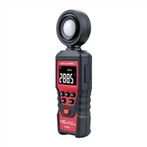
What is the physical principle of infrared thermometer?
What is the physical principle of infrared thermometers? Any object with a temperature above absolute zero will continuously emit infrared radiation energy into the space around it. The size of the infrared radiation energy of the target and its distribution on the wavelength have a great relationship with the surface temperature of the target. Therefore, by measuring the infrared energy radiated by the object itself, the surface temperature of the object can be accurately measured, which is the objective basis for infrared radiation temperature measurement.
A black body is an ideal radiator, it can absorb radiation energy of all wavelengths, and its surface emissivity is
1. It can be seen from the distribution diagram of the black body radiation spectrum under different temperature conditions that the total radiation energy increases rapidly when the temperature rises (the total radiation energy in the area surrounded by the corresponding curve and the wavelength coordinate increases rapidly); the monochromatic radiation flux has When the temperature rises, the extreme value corresponding to the wavelength moves to the short-wave direction. Therefore, the bands designed for the instrument at different temperatures are different.
The infrared thermometer adopts a point-by-point analysis method, that is, the local thermal radiation of the target is concentrated on a single detector, and the radiation power is converted into temperature by knowing the emission rate of the target. Its basic structure is mainly composed of optical system, photodetector, signal amplifier, signal processing, display output and other parts.
After the infrared radiation emitted by the radiator enters the optical system, the infrared radiation is modulated into alternating radiation by the modulator, which is converted into a corresponding electrical signal by the detector. After the amplifier and signal processing circuit, it is corrected according to the internal algorithm of the instrument and the target emissivity, and converted into the temperature value of the measured target.
Infrared thermometers mainly have three series: portable, on-line and scanning, and are equipped with various options and computer software. Each series has different models and specifications. The selection of infrared thermometers is divided into two aspects: one is performance indicators, such as temperature range, spot size, working wavelength, measurement accuracy, and response time; the other is environmental conditions, including ambient temperature, window, display output, and protective accessories Wait.