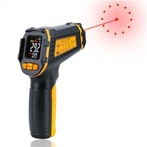
What is the principle and classification of infrared thermometer
1. Infrared principle: As long as the temperature of any object is higher than the absolute zero (-273°C), there will be thermal radiation emitted outward. The temperature of the object is different, the energy radiated is also different, and the wavelength of the radiation wave is also different. However, infrared radiation is always included. For objects below 1,000 degrees Celsius, the electromagnetic wave with the strongest heat radiation is infrared waves. Therefore, the measurement of the infrared radiation of the object itself can accurately determine its surface temperature. This is The objective basis and basic principles of infrared thermometer temperature measurement basis.
A black body is an idealized radiator, which absorbs radiation energy of all wavelengths, has no reflection and transmission of energy, and has an emissivity of 1 on its surface. However, practical objects in nature are almost not black bodies. In order to clarify and obtain the distribution law of infrared radiation, a suitable model must be selected in theoretical research. This is the quantized oscillator of body cavity radiation proposed by Planck This is the starting point of all infrared radiation theories, so it is called the law of black body radiation.
The radiation amount of all real objects depends not only on the radiation wavelength and the temperature of the object, but also on the material type, preparation method, thermal history, surface state and environmental conditions of the object. Therefore, in order to make the law of black body radiation applicable to all real objects, it is necessary to introduce a proportional coefficient related to the properties of the material and the surface state, that is, the emissivity. This coefficient represents the closeness level between the thermal radiation of the real object and the black body radiation, and its value is between 0 and 1. According to the law of radiation, as long as the emissivity of the material is known, the infrared radiation characteristics of any object can be known. The main factors affecting the emissivity of yarn are: material type, surface roughness, physical and chemical structure and material thickness.
2. The working principle and structure of the infrared thermometer: In nature, all objects with a temperature higher than the absolute zero are constantly emitting infrared radiation energy to the surrounding space. The size of the infrared radiation energy of an object and its distribution according to the wavelength have a very close relationship with its surface temperature. Therefore, by measuring the infrared energy radiated by the object itself, its surface temperature can be accurately determined, which is the objective basis for infrared radiation temperature measurement.
The temperature measurement principle of the infrared thermometer is to change the radiant energy of the infrared rays emitted by the object (such as molten steel) into an electrical signal. The size of the infrared radiant energy corresponds to the temperature of the object (such as molten steel) itself. , the temperature of the object (such as molten steel) can be determined. The infrared thermometer is composed of optical system, photoelectric detector, signal amplifier, signal processing, display output and other parts. The optical system gathers the target infrared radiation energy in its field of view, and the size of the field of view is determined by the optical parts of the thermometer and its position. Infrared energy is focused on a photodetector and transformed into a corresponding electrical signal. The signal passes through the amplifier and the signal processing circuit, and is changed into the temperature value of the measured object after being corrected according to the algorithm of the internal treatment of the instrument and the emissivity of the object.
When using an infrared radiation thermometer to measure the temperature of the target, it is first necessary to measure the infrared radiation of the target within its band range, and then the temperature of the target to be measured is calculated by the thermometer. Infrared thermometers can be divided into single-color thermometers and two-color thermometers (radiation colorimetric thermometers) according to the principle. The single-color thermometer is proportional to the radiation in the band; the two-color thermometer is proportional to the radiation in the two bands. The ratio of the amount of radiation is proportional.
3. The development and classification of infrared thermometers: Infrared temperature measurement technology has been developed to scan and measure the surface with thermal changes, determine its temperature distribution image, and quickly detect hidden temperature differences. This is the infrared thermal imager . Infrared thermal imaging cameras began to be used in the military. TI Corporation of the United States developed the world's first infrared scanning detection system. Since then, infrared thermal imaging technology has been continuously used in aircraft, tanks, warships and other weapons in Western countries as thermal sights for detection purposes. The system has greatly improved the ability to search and hit targets. Infrared thermometers are roughly classified as follows: (1) infrared spot thermometers: including portable and fixed; (2) infrared scanners; (3) infrared thermal imaging cameras.