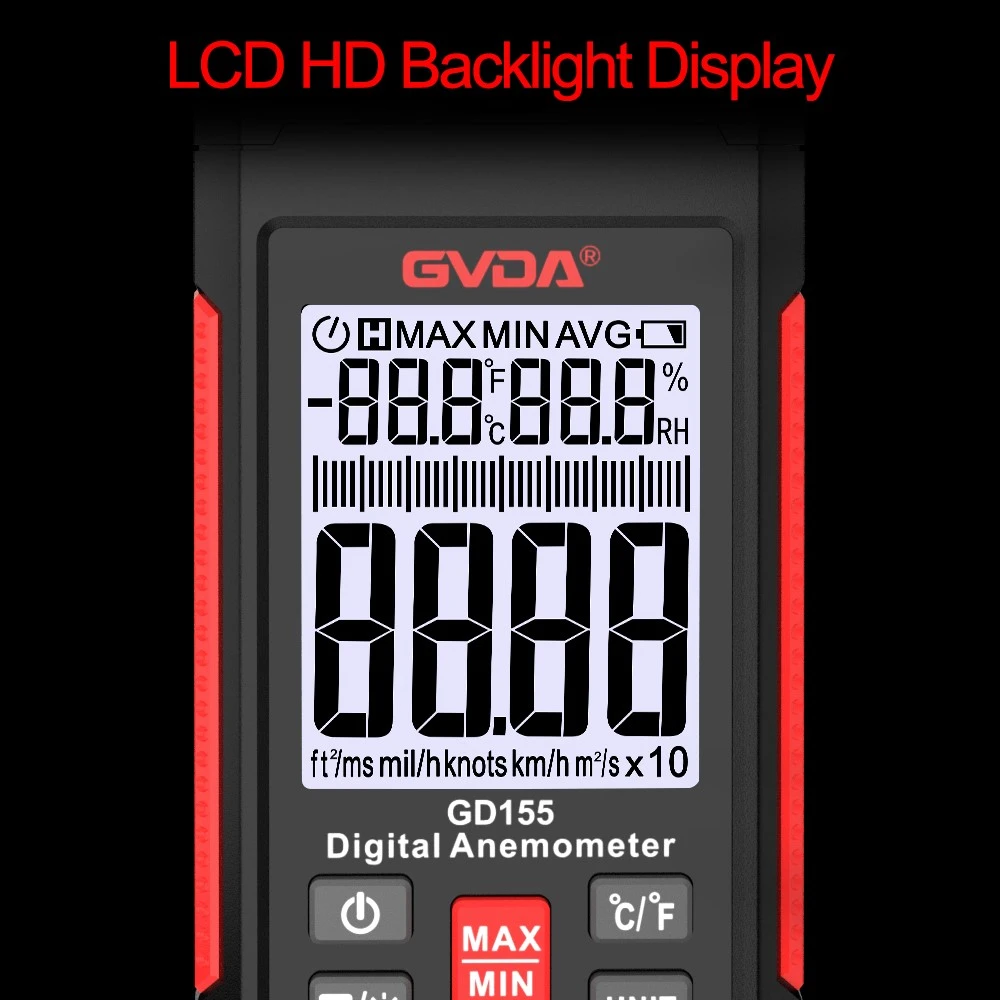
What is the Working Principle of an Anemometer?
The basic working principle of an anemometer is as follows: A thin metal wire is placed in a fluid and heated by an electric current to a temperature higher than that of the surrounding fluid, hence the metal‑wire anemometer is called a "hot wire". When the fluid flows perpendicularly across the metal wire, it carries away part of the heat and reduces the wire's temperature. Based on the theory of forced convection heat transfer, a relationship can be derived between the heat loss Q of the hot wire and the fluid velocity v.
A standard hot‑wire probe consists of a short, fine metal wire tensioned between two supports. The metal wire is usually made of metals with high melting points and good ductility, such as platinum, rhodium and tungsten. Commonly used wires have a diameter of 5 μm and a length of 2 mm; miniature probes may be only 1 μm in diameter and 0.2 mm in length. Depending on different application requirements, hot‑wire probes are also manufactured in double‑wire, triple‑wire, inclined‑wire, V‑shape and X‑shape configurations. To improve mechanical strength, a metal foil is sometimes used instead of metal wire. A thin metal film is usually sputtered onto a thermally insulated substrate, and this type is known as a hot‑film probe.
Hot‑wire probes must be calibrated before use. Static calibration is carried out in a dedicated standard wind tunnel to measure the relationship between flow velocity and output voltage and plot a standard calibration curve. Dynamic calibration is performed in a known pulsating flow field, or a pulsating electrical signal is injected into the heating circuit of the anemometer to verify the frequency response of the hot‑wire anemometer. If the frequency response is poor, it can be improved with a corresponding compensation circuit.
The flow velocity measuring range of 0 to 100 m/s is divided into three sections: low speed: 0 to 5 m/s; medium speed: 5 to 40 m/s; high speed: 40 to 100 m/s.
The thermal probe of the anemometer is used for measurements from 0 to 5 m/s; the vane probe delivers optimal performance for flow velocities of 5 to 40 m/s; the Pitot tube achieves the best results in the high‑speed range.
An additional criterion for properly selecting an anemometer flow probe is temperature. The operating temperature of a thermal sensor of a conventional anemometer is approximately ±70 °C. Special vane probes for anemometers can withstand up to 350 °C, while Pitot tubes are used for temperatures above +350 °C.