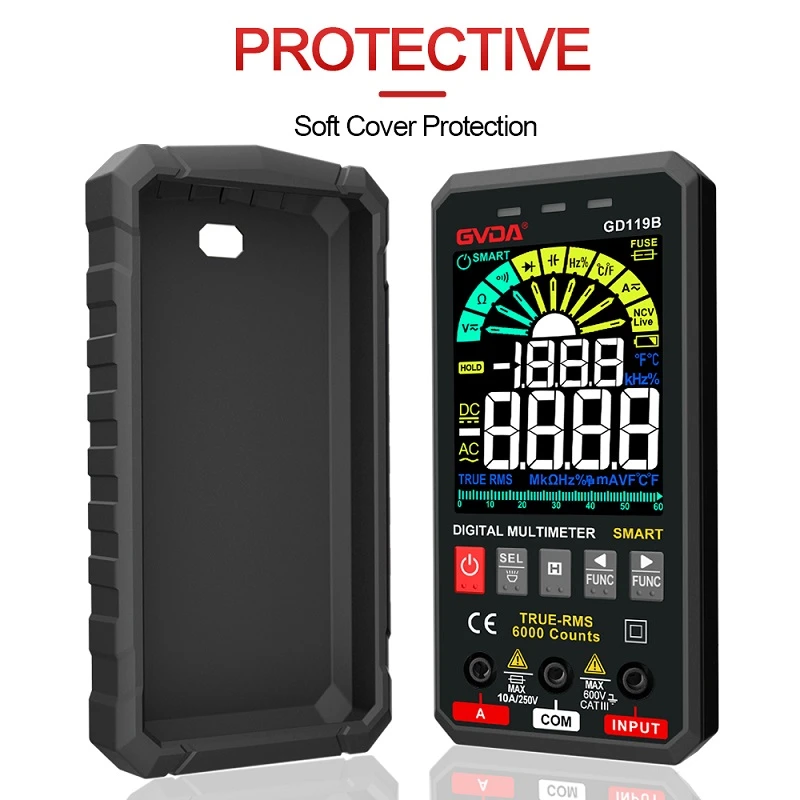
What kind of multimeter is good for repairing home appliances and testing electrical appliances?
Basic usage of pointer multimeter:
(1) Before the test, first place the multimeter in a horizontal state, and check whether the needle is at zero (referring to the zero point of the current and voltage scales). If not, adjust the "mechanical zero adjustment" under the meter head to make the pointer point to zero.
(2) According to the item to be measured, correctly select the measurement item and range switch on the multimeter. If the order of magnitude to be measured is known, select the corresponding order of magnitude range. If you do not know the magnitude of the measured value, you should start measuring from the maximum range, and then reduce the range when the pointer deflection angle is too small to read accurately. Generally, the pointer deflection angle is not less than 30% of the maximum scale as a reasonable range.
(3) The multimeter is used as an ammeter
① When connecting the multimeter in series to the circuit under test, attention should be paid to the direction of the current. That is, connect the red test lead to the end where the current flows in, and the black test lead to the end where the current flows out. If you don't know the direction of the current to be measured, you can connect a test lead at one end of the circuit first, and touch the other test lead at the other end of the circuit lightly. If the pointer swings to the right, the wiring is correct; if the pointer is to the left If it swings (lower than zero), it means that the wiring is incorrect, and the positions of the two test leads of the multimeter should be exchanged.
②When the deflection angle of the pointer is greater than or equal to 30% of the maximum scale, try to use a large range file. Because the larger the measuring range, the smaller the shunt resistance, the smaller the equivalent internal resistance of the ammeter, and the smaller the error introduced by the circuit under test.
③ When measuring a large current (such as 500mA), do not toggle the range selection switch during the measurement process, so as not to generate arcs and burn out the contacts of the transfer switch.
(4) The multimeter is used as a voltmeter
①Connect the multimeter to the circuit under test. When measuring the DC voltage, pay attention to the polarity of the voltage at the point under test, that is, connect the red test lead to the high voltage end and the black test lead to the low voltage end. If you don't know the polarity of the voltage to be measured, you can try it according to the above-mentioned tentative method when measuring the current. If the pointer deflects to the right, you can measure; if the pointer deflects to the left, exchange the positions of the red and black test leads. Measurement.
②Same as the above-mentioned ammeter, in order to reduce the error introduced by the internal resistance of the voltmeter, when the deflection angle of the pointer is greater than or equal to 30% of the maximum scale, try to select a large range for measurement. Because the larger the measuring range, the larger the voltage dividing resistance, and the larger the equivalent internal resistance of the voltmeter, the smaller the error introduced to the circuit under test. If the internal resistance of the circuit under test is large, the internal resistance of the voltmeter is required to be larger to make the measurement accuracy high. At this time, it is necessary to use a multimeter with higher voltage sensitivity (larger internal resistance) for measurement. For example, the maximum DC voltage sensitivity (100 kΩ/V) of the MFl0 multimeter is higher than that of the ME30 type multimeter (20 kΩ/V).
③ When measuring the AC voltage, it is not necessary to consider the polarity problem, as long as the multimeter is connected to both ends of the test. In addition, it is generally not necessary to choose a multimeter with a large range or a high voltage sensitivity. Because under normal circumstances, the internal resistance of the AC power supply is smaller than that of the glue. It is worth noting that the measured AC voltage can only be a sine wave, and its frequency should be less than or equal to the allowable operating frequency of the multimeter, otherwise a large error will occur.
④ Do not toggle the range selection switch when measuring a higher voltage (such as 220v), so as not to generate arcs and burn out the contacts of the transfer switch.
⑤ Pay attention to safety when measuring high voltage greater than or equal to 100v. It is best to fix one test lead on the common ground of the circuit under test, and then use another test lead to touch the other test point.
⑥The level is commonly used in the circuit system to represent the effective value of the voltage at this point. Therefore, the multimeter has a level scale on the AC voltage range. Zero level refers to the power of 1mW generated on the 600 ohm impedance, that is, the corresponding effective voltage value is 0.75V. If the impedance of the circuit under test is not equal to 600 ohms, calculate according to the following formula: actual electronic value = multimeter dB reading + 101g (600/z) where z is the resistance value of the circuit under test. It is worth pointing out that when measuring the level, it should be placed on the 10v file, because the level scale of the multimeter is designed and calculated on this file. If the range is not enough, you need to change to another file to measure. In addition, the multimeter is only suitable for measuring the volume and frequency levels, such as circuit There is a DC voltage on it, and a 0.1uF/450V capacitor must be connected in series to cut off the DC before measuring
⑦ When measuring the voltage in a circuit with inductive reactance, the multimeter must be disconnected and then turned off after the measurement. Otherwise, when the power is cut off, due to the self-inductance of the inductive components in the circuit, high voltage will be generated and the multimeter may be burned out.
(5) The multimeter is used as an ohmmeter
① When measuring, it should be zeroed first. That is, touch the two test leads directly (short circuit), and adjust the dial—the zero-ohm adjuster below to make the pointer point to 0 ohm correctly. This is because the power supply voltage provided by the internal dry battery will drop as the use time increases. When Rx=0, the pointer may not reach full bias. At this time, Rw must be adjusted to reduce the shunt current of the meter head. To meet the requirements of full bias current Ig.
②In order to improve the accuracy of the test and ensure the safety of the measured object, it is necessary to correctly select the appropriate range file. Generally, when measuring resistance, the pointer is required to be within the range of 20%-80% of the full scale, so that the test accuracy can meet the requirements.
③Due to the different ranges, the test current flowing through Rx is also different. The smaller the range, the larger the test current, otherwise the opposite. Therefore, if the small-range ohm range RX1 and RX10 of the multimeter are used to measure a small resistance Rx (such as the internal resistance of a milliampere meter), a large current will flow through Rx. If the current exceeds the current allowed by Rx, Rx It will burn out, or bend the pointer of the mA meter. Therefore, when measuring a resistance that does not allow a large current to pass, the multimeter should be placed on a large range of ohms. At the same time, the larger the range, the higher the voltage of the dry battery connected to the internal resistance. Therefore, when measuring a resistance that cannot withstand high voltage, the multimeter should not be placed on the ohm range with a large range. For example, when measuring the inter-electrode resistance of a diode or triode, the ohm gear cannot be set to the Rxl0k gear, otherwise it is easy to break down the inter-electrode of the tube. You can only lower the range and let the pointer point to the high resistance end. However, it has been pointed out that the resistance scale is non-linear, and the scale at the high resistance end is very dense, which will easily cause an increase in error. When used as an ohmmeter by the factory, the dry battery is connected inside, the negative pole of the battery, and the black test lead is connected to the positive pole of the dry battery. For the external circuit, the red test lead is connected to the dry battery. When measuring a large resistance, the hands cannot touch both ends of the measured resistance at the same time, otherwise, the human body resistance will be connected in parallel with the measured resistance, making the measurement result incorrect and the test value will be greatly reduced. In addition, when measuring the resistance on the circuit, the power supply of the circuit should be cut off, otherwise not only the measurement result will be inaccurate (equivalent to an external voltage), but also a large current will flow through the microampere meter, which will burn out the meter. At the same time, one end of the resistance to be tested should be welded away from the circuit before measurement, otherwise the measured resistance is the total resistance of the circuit at the two points.
(6) Do not put the range switch on the ohm position after use. In order to protect the micro-ampere meter head, so as not to accidentally burn the meter head when starting to measure next time. After the measurement is completed, you should pay attention to turn the range switch to the maximum range position of DC voltage or AC voltage, and never put it on the ohm gear, in case the two test leads are short-circuited, the internal dry battery will be completely exhausted.