What the sound level meter does
Whether the sound level meter is used correctly or not directly affects the accuracy of the measurement results. Therefore, it is necessary to introduce the use of sound level meters.
1. Selection of the environment in which the sound level meter is used: select a representative test location, and the sound level meter should be kept away from the ground and the wall to reduce the additional impact of the reflected sound from the ground and walls.
2. The weather conditions require that the sound level meter should keep the diaphragm of the microphone clean when there is no rain or snow. When the wind force is above level 3, a wind cover must be added (to avoid wind noise interference), and the measurement should be stopped for strong winds above level 5.
3. Open the carrying case of the sound level meter, take out the sound level meter, and put on the sensor.
4. Put the sound level meter in state A, check the battery, and then calibrate the sound level meter.
5. Use the comparison table (commonly referred to as environmental sound level) to adjust the measurement range.
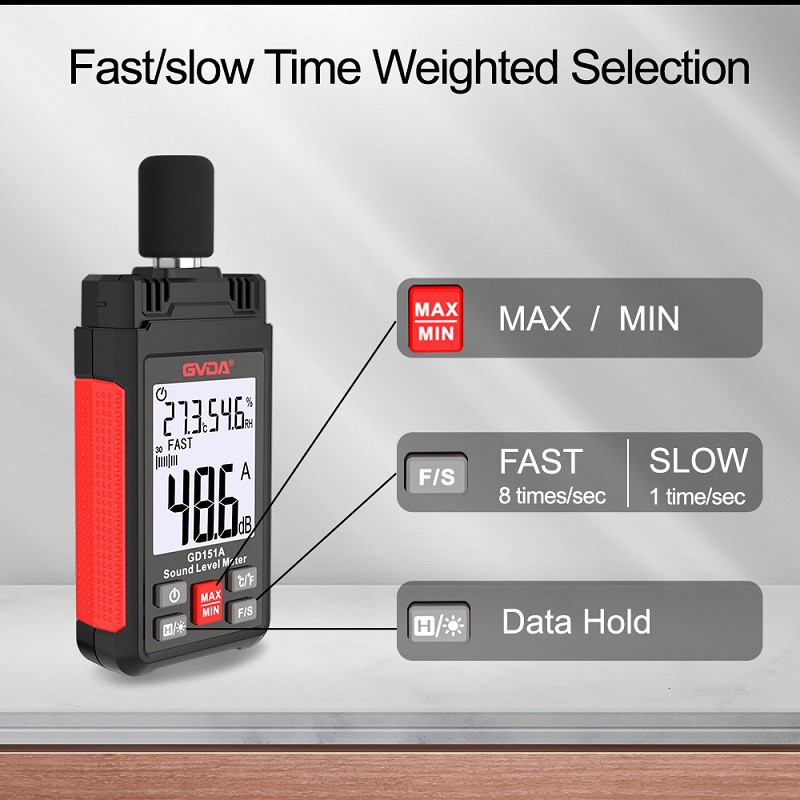
6. The following can be used fast (measure the instantaneous value of the environment where the sound pressure level changes greatly), slow (measure the average value in the environment where the sound pressure level does not change much), pulse (measure the pulse sound source), filter ( Measure the sound level of the specified frequency band) Various functions are used for measurement.
7. Record data as needed, and also connect to a printer or other computer terminals for automatic collection.
The structure of the sound level meter
The sound level meter is composed of a microphone, an attenuator (amplifier), a weighting network, an RMS detector, and an indicator head.
The measured sound pressure signal is converted into a voltage signal through a microphone, and the voltage signal is passed through an attenuator, an amplifier and a corresponding weighting network (or an external filter), or input to an external recording instrument, or directly through an RMS detector. Push the indicator gauge scaled in decibels.
The weighting network is a filter circuit designed based on the equal loudness curve, which is divided into four types: A, B, C, and D.
The sound pressure level measured by the weighting network is called weighted sound pressure level.
The sound pressure levels measured corresponding to the four weighting networks are called A sound level (LA), B sound level (LB), C sound level (LC) and D sound level (LD), respectively recorded as dB (A) , dB(B), dB(C) and dB(D).
The three weighting networks have different degrees of attenuation for low-frequency noise, A is the strongest attenuation, B is the second, and C is the weakest. Among them, the A-weighting network has the strongest attenuation of low-frequency noise, and the most sensitive response to high-frequency noise, which is close to the human ear's perception of noise. Therefore, the A-weighting network is used in the measurement of noise that is harmful to the human ear. The D-weighting network is specially designed for aircraft noise measurement.