Why Choose Infrared Thermometers?
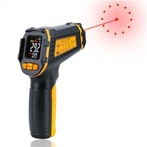
1. Infrared thermometers use infrared technology to quickly and conveniently measure the surface temperature of objects. Quickly measure temperature readings without the need for mechanical contact with the object being measured. Just aim, press the trigger, and read the temperature data on the LCD screen.
Infrared thermometers are lightweight, small in size, easy to use, and can reliably measure hot, dangerous, or difficult to reach objects without contaminating or damaging the object being measured.
Infrared thermometers can measure several readings per second, while contact thermometers require several minutes to measure per second.
2, How does an infrared thermometer work?
Infrared thermometers receive invisible infrared energy emitted by various objects themselves. Infrared radiation is a part of the electromagnetic spectrum, which includes radio waves, microwaves, visible light,

ultraviolet, R rays, and X-rays. Infrared is located between visible light and radio waves, and its wavelength is commonly expressed in micrometers, with a wavelength range of 0.7 micrometers to 1000 micrometers. In fact, the 0.7 micrometers to 14 micrometers wavelength band is used for infrared thermometers.
3, How to ensure the accuracy of infrared thermometer temperature measurement?
The undisputed understanding of infrared technology and its principles is its precise temperature measurement. When measured by an infrared thermometer, the infrared energy emitted by the object being measured is converted into an electrical signal on the detector through the optical system of the infrared thermometer, and the temperature reading of the signal is displayed.
There are several important factors that determine precise temperature measurement, including emissivity, field of view, distance to the light spot, and position of the light spot.
missivity, all objects reflect, transmit, and emit energy, and only the emitted energy can indicate the temperature of the object. When an infrared thermometer measures surface temperature, the instrument can receive all three types of energy. Therefore, all infrared thermometers must be adjusted to read only the emitted energy. Measurement errors are usually caused by infrared energy reflected by other light sources. Some infrared thermometers can change emissivity, and emissivity values for various materials can be found in published emissivity tables. The other instruments have a fixed preset emissivity of 0.95. The emissivity value is compensated for the surface temperature of most organic materials, paints, or oxidized surfaces by applying a tape or flat black paint to the tested surface. When the tape or paint reaches the same temperature as the base material, measure the surface temperature of the tape or paint to obtain its true temperature.