Why doesn't the digital multimeter display the forward and reverse resistance of the diode?
Why can't diodes be measured with resistance files?
The unidirectional conductivity of the diode is conditional, that is, the PN junction of the diode is forward biased before conducting. Simply using the resistance gear to measure the resistance, the diode itself is not conductive, so the resistance can not be measured. The diode gear of the multimeter is usually about 1.5-2.8V with voltage. When measuring the diode, the voltage is actually applied to both ends of the diode, so that the PN junction is forward biased. Only then can the voltage drop of about 0.7V be seen on the multimeter, which proves that the diode is good. The resistance measured by the pointer meter is not accurate, and the values obtained by measuring different diodes are also different.
Method of measuring diode with multimeter
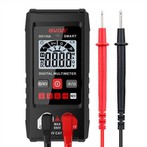
The diode must be measured with the diode gear of multimeter. Turn the multimeter to the diode position, insert the red probe into the positive end and the black probe into the negative end.
Touch the two electrodes of the diode under test with a red stylus and a black stylus. If the diode shows a voltage drop of about 0.7V, it means that one end contacted by the red stylus is the anode of the diode and the other side is the cathode of the diode.
Switch the direction of the diode to be tested. If the voltage value cannot be measured, it indicates that the red stylus contacts the negative electrode of the diode and the black stylus contacts the positive electrode of the diode.
After the above two measurements, the anode and cathode of the diode can be confirmed, and the quality of the diode can be confirmed.
When the digital multimeter is in the resistance range, the voltage between the two probes is low, which is about 0.6-0.7V lower than the forward conduction voltage of ordinary silicon diode, and the diode is in the off state. The resistance value of the off state is very large, so when measuring the diode with a digital multimeter, whether it is forward or backward, the displayed value overflows. Digital multimeters all have diode measuring gear, which should be used to measure the forward and reverse on-off of diodes.
In addition, the diode is a nonlinear element, and its resistance value is not fixed. When measuring the forward on-resistance of the diode with pointer multimeter resistance, it can be seen that the resistance values of different gears are very different. Therefore, it is of little significance to measure the resistance value of diode with multimeter, as long as it can measure the forward conduction and reverse cutoff, or distinguish the positive and negative poles and whether there is breakdown or burning, and it is not necessary to read the specific resistance value.
The digital multimeter has a special diode-measuring diode. If it is necessary to use resistance measurement, the diode has a resistance value of more than tens of K in the reverse direction, so the meter shows overflow 1. There are several hundred ohms to several k in the forward direction, because the resistance is different because of the different voltages applied across the semiconductor diode. Therefore, the diode is generally measured with a special gear, the reverse direction is generally 1 (overflow), and the forward direction is between 300 and 750 (this is actually the voltage drop), mostly around 600 (silicon) and below 500 (germanium) tubes.