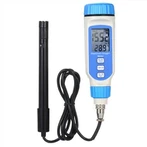
Why is it "inaccurate" to measure curved surface materials such as pipes and rods?
Answer: The curvature change has a great influence on the coating thickness gauge. If you directly measure the curved surface after calibrating the zero point on the flat substrate, the measured value must be biased. The correct operation must be on the unpainted workpiece with the same curvature radius Zero point calibration is performed on the substrate, and then the coating thickness is measured, and the measured value at this time is accurate.
How to judge when the test piece measured by the instrument is accurate and there is a "deviation" when measuring the coating of the workpiece?
Answer: Some users may find that the measurement on the random matrix test piece is accurate during use, but there is a deviation in the measurement on the workpiece, or there is a deviation in the measurement of the same workpiece by instruments from different manufacturers. In this case, users often do not know the cause The problem with your own process is the problem of the instrument itself, whether it is the standard of the times or other manufacturers. This problem is easy to solve, we just need to put the test piece (provided by China Institute of Metrology) that comes with it on the user's own unpainted workpiece substrate to measure it, because the value of the test piece is constant, and It is provided by the third party China Metrology Institute. If the measurement of the test piece on the workpiece is also accurate, it means that there is nothing wrong with the instrument. It is the same reason to use this method to compare the instruments of two different manufacturers.
Working principle of coating thickness gauge
The thickness of the coating was measured by the electromagnetic induction method. The probe located on the surface of the component generates a closed magnetic circuit. As the distance between the probe and the ferromagnetic material changes, the magnetic circuit will change to varying degrees, causing changes in the magnetic resistance and inductance of the probe coil. Using this principle, the distance between the probe and the ferromagnetic material, that is, the coating thickness, can be accurately measured.
The series coating thickness gauge adopts the latest technology of Kedian, which has the characteristics of high precision, stable display value, low power consumption, high resolution, and humanized operation interface. Its newly added functions include: batch management data, multiple online monitoring measurement modes, multiple calibration methods, etc., which make the instrument more suitable for the work needs of industrial sites and provide customers with more convenience. Its performance has reached the advanced level of contemporary international similar instruments.