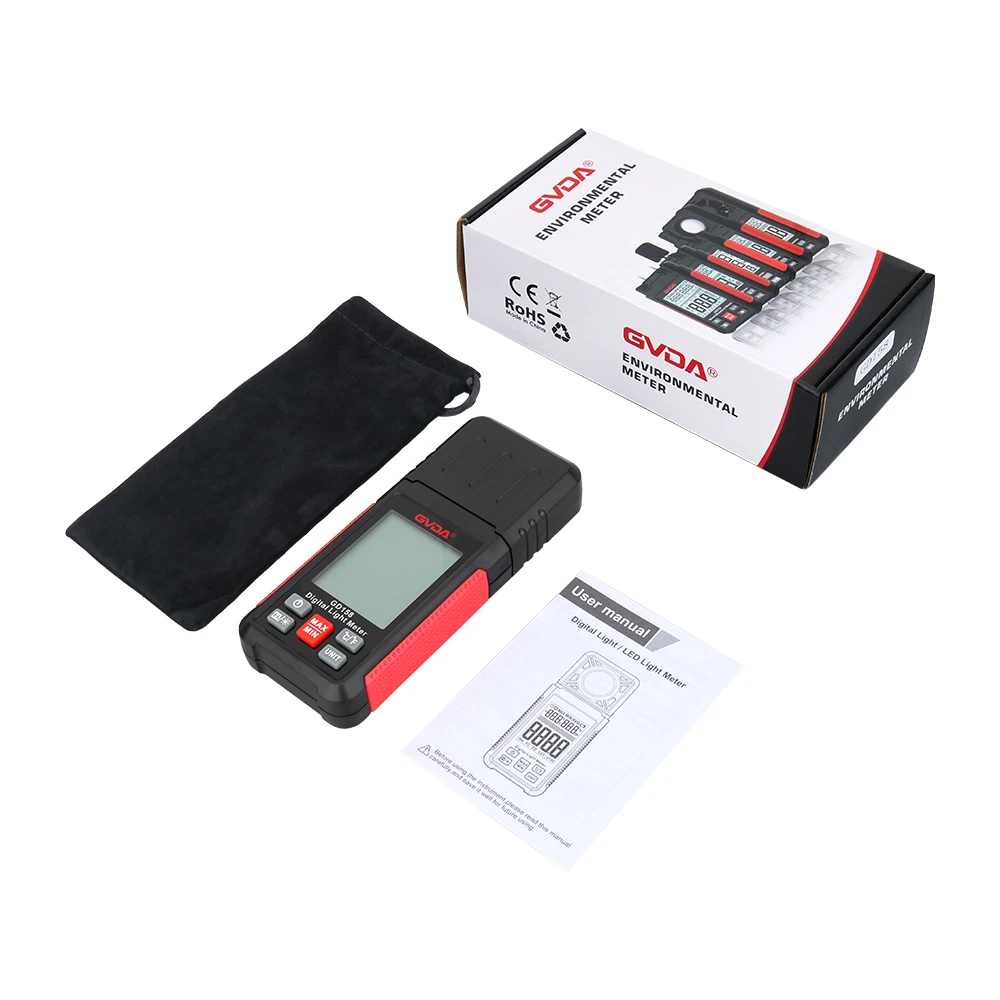
Working principle of illuminance meter_General requirements and classification of illuminance meter
How Light Meters Work
Using a germanium photocell as a probe, the current generated by the photocell is different due to the different light intensity, and then the current is amplified by DC, and then the DC signal is converted into a digital signal that directly reflects the intensity of light through a digital-to-analog conversion circuit.
General Requirements for Luxmeters
1. Small size and light weight (CompactSize, LightWeight)
The opportunity to use the illuminance meter is very wide, and the timing of application is often in different places, so the first prerequisite for the portable illuminance meter is small size and light weight.
2. Accuracy﹝Accuracy﹞
Whether the illuminance meter is good or not has an absolute relationship with its accuracy. Of course, it is also closely related to its price, so it is necessary to buy a lux meter with high accuracy at a reasonable price. Generally, the error should not exceed ±15%.
3. Color Compensation (Color Compensation)
The types of light sources are all-encompassing. Some focus on red high-pressure lamps with longer wavelengths, or blue-violet ones with shorter wavelengths such as Daylight fluorescent lamps; there are also more evenly distributed ones such as incandescent bulb series. The sensitivity of the same illuminance meter to different wavelengths may be slightly different. Therefore, appropriate compensation is necessary.
4. Cosine Compensation﹝Cosine Compensation﹞
We all know that the brightness of the illuminated surface is related to the incident angle of the light source. In the same way, when measuring with a light meter, the incident angle between the sensor (Sensor) and the light source will naturally affect the reading value of the light meter. Therefore, whether a good illuminance meter has the function of cosine compensation cannot be ignored.
Classification of illuminance meters
1. Visual illuminance meter: it is inconvenient to use, the accuracy is not high, and it is rarely used.
2. Photoelectric illuminance meter: selenium photocell illuminance meter and silicon photocell illuminance meter are commonly used.
Application of Luxmeter
1. Application in general public places
In order to ensure that people can live under suitable light, our country has formulated health standards for indoor (including public places) illuminance, and uses illuminometers to measure the illuminance of various places.
2. Lighting production industry, photography industry, stage lighting layout, etc.
The illuminance meter has been successfully applied to many projects, such as lighting production industry, photography industry, stage lighting layout, etc. Different models of illuminance meters can meet different measurement requirements.
3. Factory production line application
In the factory, the illumination requirements on the production line are relatively strict, continuous work will cause visual fatigue, and work efficiency will be greatly reduced. Usually, the illumination requirement is ≥1000Lx. For places with relatively high illumination requirements, a large-range illuminance meter can be selected, with a super-large range. Can deal with strong light illumination measurement.
4. The application of illuminance meters is very extensive, including the applications in our daily life, such as factories, warehouses, schools, offices, homes, street lamp construction, laboratories and so on.