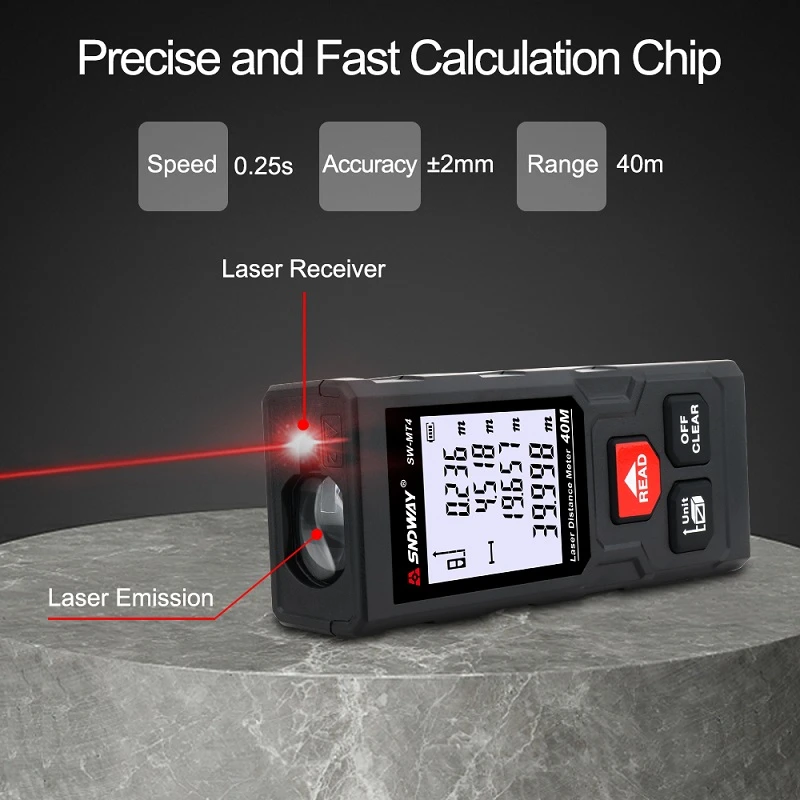
Working Principle of Laser Rangefinders
① It can measure diffuse reflection on the plane of an object. Generally, measurement is feasible. In practical engineering, thin plastic boards are used as reflecting surfaces to tackle severe diffuse reflection issues.
② Principles of infrared ranging or laser ranging The ranging principle basically boils down to measuring the time required for light to travel to the target and back. The distance D is then calculated using the speed of light c =299792458 m/s and the atmospheric refractive index n. Since direct time measurement is difficult, continuous wave phase measurement is commonly adopted; instruments of this type are known as phase-shift rangefinders. There are also pulse rangefinders, and a typical model is the WILD DI-3000.
It should be noted that phase measurement does not measure the phase of infrared or laser light itself, but the phase of the signal modulated onto the infrared or laser beam. Handheld laser rangefinders used in the construction industry for housing surveys operate on this same principle.
③ Laser rangefinders can achieve an error of 1 mm, suitable for various high-precision measurement applications.
Precautions for using laser rangefinders: Do not aim the laser rangefinder directly at human eyes during measurement to avoid personal injury. In addition, most ordinary laser rangefinders are not waterproof, so water protection must be observed. The Leupold laser rangefinder from the United States is mainly designed for outdoor hunting enthusiasts in the US. Its built-in advantages include waterproof and fog-proof performance, and it is finished with camouflage paint for woodland environments.
④ The measured object plane must be perpendicular to the light beam. High-precision ranging usually requires the use of a total reflection prism. However, rangefinders for building measurement can perform measurements directly by reflection off smooth walls. This is mainly because the measurement distance is relatively short, and the reflected light signal has sufficient intensity. Therefore, the beam must strike perpendicularly; otherwise, the return signal will be too weak to calculate the distance.