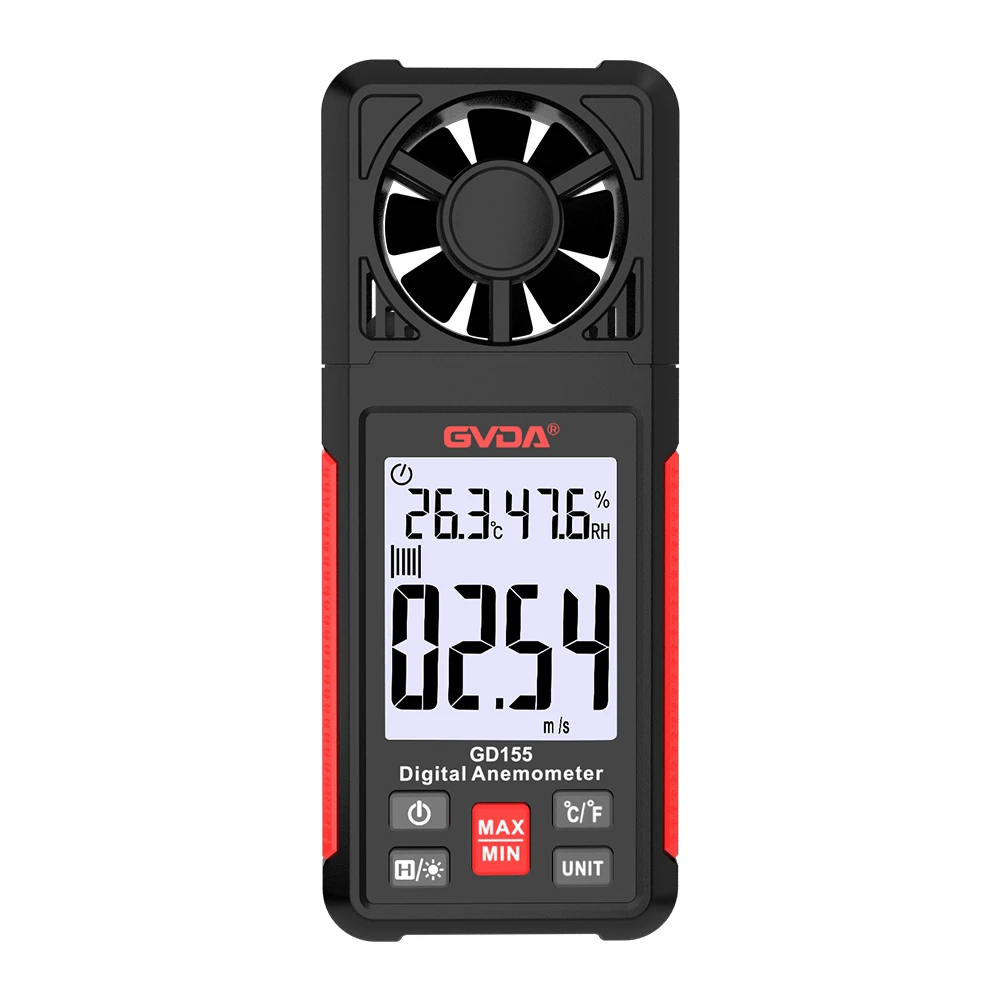
Working principle of the thermal probe of anemometer
The working principle of the thermal sensitive probe of the anemometer is based on the cold shock airflow carrying away the heat from the heating element. With the help of an adjustment switch, the temperature is kept constant, and the current and flow rate are proportional to each other. When using a thermal sensitive probe in turbulence, airflow from all directions simultaneously impacts the thermal element, which can affect the accuracy of the measurement results. When measuring in turbulence, the reading of the thermal anemometer velocity sensor is often higher than that of the rotary probe. The above phenomenon can be observed during the pipeline measurement process. According to different designs for managing turbulent flow in pipelines, it may even occur at low speeds. Therefore, the measurement process of the anemometer should be carried out in the straight section of the pipeline. The starting point of the straight section should be at least 10 × D (D=pipe diameter, in CM) outside the measuring point; The endpoint should be at least 4 × D behind the measurement point. The fluid cross-section must not have any obstruction. (Sharp edges, heavy suspension, objects, etc.)
Hot wire characteristics of anemometer
The length of the hot wire is generally in the range of 0.5-2 millimeters, and the diameter is in the range of 1-10 micrometers. The material used is platinum, tungsten, or platinum rhodium alloy. If a very thin (less than 0.1 microns thick) metal film is used instead of a metal wire, it is called a hot film anemometer, which functions similarly to a hot wire but is mostly used to measure liquid flow velocity. In addition to the ordinary single line type, the hotline can also be a combination of double line or triple line type, used to measure velocity components in various directions. The electrical signal output from the hotline, after amplification, compensation, and digitization, can be input into the computer to improve measurement accuracy, automatically complete the data post-processing process, expand the speed measurement function, and simultaneously measure instantaneous and mean values, combined and partial velocities, turbulence intensity, and other turbulence parameters. Compared with pitot tubes, the hot wire anemometer has a smaller probe volume and less interference with the flow field; Fast response, capable of measuring unsteady flow velocity; It has the advantage of being able to measure very low speeds (such as as as low as 0.3 meters per second).