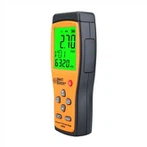
How to use leakage clamp Ammeter
Principle of leaky clamp Ammeter:
The leakage current clamp meter mainly consists of impedance conversion, range conversion, AC/DC conversion, amplification, indication devices, etc. Some also have overcurrent protection, sound and light alarm circuits, and test voltage regulation devices, with indication devices divided into analog and digital types. According to the US UL standard, leakage current refers to the current that can be conducted from the accessible part of household appliances, including capacitive coupling current. The leakage current consists of two parts, one is the conduction current I1 through the insulation resistance; The other part is through the displacement current I2 of the distributed capacitor, which has a capacitance impedance of XC=1/2pfc inversely proportional to the power frequency. The distributed capacitor current increases with the increase of frequency, so the leakage current increases with the increase of power frequency. For example, when using thyristor power supply, the harmonic component increases the leakage current.
If the insulation performance of a circuit or system is evaluated, this current should include not only all currents flowing into the ground (or conductive parts outside the circuit) through insulating materials, but also currents flowing into the ground through capacitive devices (distributed capacitors can be considered as capacitive devices) in the circuit or system. Long wiring can form a larger distribution capacity and increase leakage current, which should be particularly noted in ungrounded systems.
Precautions for leakage clamp Ammeter:
The principle of measuring leakage current is basically the same as that of insulation resistance. Measuring insulation resistance is actually a type of leakage current, but it is expressed in the form of resistance. However, the formal measurement of leakage current applies AC voltage, so the capacitive component of the current is included in the component of the leakage current.
2. When conducting voltage withstand tests, in order to protect the testing equipment and test according to the specified technical indicators, it is also necessary to determine a high current value that is allowed to flow through the tested equipment (insulation material) without damaging the high electric field strength. This current is usually referred to as leakage current, but this requirement is only used in the specific situations mentioned above. Please pay attention to the differences.
3. Leakage current is actually the current flowing through the insulation part of an electrical circuit or equipment without any faults or applied voltage. Therefore, it is one of the important indicators to measure the insulation quality of electrical appliances and is the main indicator of product performance.
4. The leakage current tester is used to measure the leakage current generated by the working power supply (or other power sources) of electrical appliances through insulation or distributed parameter impedance, which is unrelated to the work. Its input impedance simulates the impedance of the human body.
Operation method of leakage clamp Ammeter:
1. Plug in the power supply, turn on the power switch, and the power indicator light will be on;
2. Select the power range and press the required current button;
3. Select the leakage current alarm value;
4. Select the testing time;
5. Connect the measured object to the measurement terminal, start the instrument, raise the test voltage to 1.06 times (or 1.1 times) the rated working voltage of the measured object, switch the phase conversion switch, take secondary readings, and select the leakage current value with the larger value. When the transfer switch K is connected to the zero line, the tester samples the leakage current between the neutral line and the shell; When K is connected to the phase line, the leakage current between the phase line and the shell is tested.
6. It must be noted that when K is connected to the zero line or K is connected to the phase line, the leakage current may not necessarily be the same. This is because the location of insulation weaknesses in household appliances is random. Therefore, the leakage current test should be conducted by converting the polarity through K, and taking the larger value as the leakage current value of the tested electric heating device.