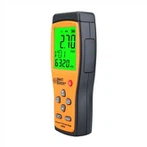
What is the difference between the principle of measuring resistance with a shaker and the measurement of resistance with a multimeter?
Megger, also known as megohmmeter, is mainly used to measure the insulation resistance of electrical equipment. It is composed of alternator voltage doubler rectifier circuit, meter and other components. When the megger shakes, a DC voltage is generated. When a certain voltage is applied to the insulating material, an extremely weak current will flow through the insulating material. This current consists of three parts, namely capacitive current, sink current and leakage current. The ratio of the DC voltage generated by the megger to the leakage current is the insulation resistance. The test of using the megger to check whether the insulating material is qualified is called the insulation resistance test. It can find out whether the insulating material is damp, damaged, or aging, so as to find equipment defects. The rated voltage of the megger is 250, 500, 1000, 2500V, etc., and the measurement range is 500, 1000, 2000MΩ, etc.
Insulation resistance tester is also called megohmmeter, shaking meter and Meg meter. The insulation resistance meter mainly consists of three parts. The DC high voltage generator is used to generate a DC high voltage. ** is the measuring circuit. The third is display.
(1) DC high voltage generator
To measure insulation resistance, a high voltage must be applied at the measuring end. The high voltage value is specified in the national standard of insulation resistance meter as 50V, 100V, 250V, 500V, 1000V, 2500V, 5000V...
There are generally three methods for generating DC high voltage. The first type of hand generator. At present, about 80% of the megohmmeters produced in our country adopt this method (the source of the name of the shaker meter). One is to step up the voltage through the mains transformer and rectify it to obtain DC high voltage. The method adopted by the general mains type megohmmeter. The third is to use transistor oscillation or special pulse width modulation circuit to generate DC high voltage, which is generally used by battery-type and mains-type insulation resistance meters.
(2) Measuring circuit
In the megger (megohmmeter) mentioned above, the measurement circuit and the display part are combined into one. It is completed with a current ratio meter head, which is composed of two coils with an angle of 60° (about), one of which is parallel to both ends of the voltage, and the other coil is connected in series with the measurement circuit middle. The deflection angle of the meter pointer is determined by the current ratio in the two coils. Different deflection angles represent different resistance values. The smaller the measured resistance value is, the greater the coil current in the measurement circuit is, and the greater the pointer deflection angle is. . Another method is to use a linear ammeter for measurement and display. Because the magnetic field in the coil is non-uniform in the meter head of the current ratio meter used above, when the pointer is at infinity, the current coil is just at the place where the magnetic flux density is the strongest, so although the measured resistance is large, the current flowing through the current coil Rarely, the deflection angle of the coil will be larger at this time. When the measured resistance is small or 0, the current flowing through the current coil is large, and the coil has been deflected to a place where the magnetic flux density is small, and the resulting deflection angle will not be very large. This achieves a non-linear correction. Generally, the resistance value display of the megohmmeter head needs to span several orders of magnitude. However, it will not work when a linear ammeter head is directly connected to the measurement circuit. When the resistance is high, the scales are all crowded together and cannot be distinguished. In order to achieve nonlinear correction, a nonlinear element must be added to the measurement circuit. So as to achieve a shunt effect at a small resistance value. There is no shunt at high resistance, so that the resistance value can reach several orders of magnitude.
500 type)
The multimeter is composed of three main parts: meter head, measuring circuit and transfer switch.
(1) Meter head: It is a high-sensitivity magnetoelectric DC ammeter. The main performance indicators of the multimeter basically depend on the performance of the meter head. The sensitivity of the meter head refers to the DC current value flowing through the meter head when the pointer of the meter head is deflected at full scale. The smaller the value, the higher the sensitivity of the meter head. The greater the internal resistance when measuring voltage, the better its performance. There are four scale lines on the meter head, and their functions are as follows: the first line (from top to bottom) is marked with R or Ω, indicating the resistance value, and when the switch is in the ohm block, read this scale line. **The bar is marked with ∽ and VA, indicating the AC, DC voltage and DC current value, when the transfer switch is in the AC, DC voltage or DC current position, and the range is in other positions except AC 10V, read this scale Wire. The third line is marked with 10V, which indicates the AC voltage value of 10V. When the switch is in the AC and DC voltage range and the range is AC 10V, read this scale line. The fourth bar, labeled dB, indicates the audio level.
(2) Measurement line
The measurement circuit is a circuit used to convert various measured objects into a small DC current suitable for meter measurement. It is composed of resistors, semiconductor components and batteries.
It can convert various measured objects (such as current, voltage, resistance, etc.) and different ranges into a certain amount of tiny DC current through a series of processing (such as rectification, shunting, voltage division, etc.) gauge to measure.
(3) Transfer switch
Its function is to select a variety of different measurement lines to meet the measurement requirements of different types and ranges. There are generally two transfer switches, marked with different gears and ranges.