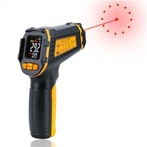
14 Highly Practical Tips for Using a Multimeter
1. Before using a multimeter, it should be mechanically zeroed first;
2. During the measurement process, do not touch the metal part of the probe with your hands to ensure both accuracy and personal safety;
3. In complex environments, attention should be paid to the impact of external magnetic fields on multimeters;
4. To improve measurement accuracy, try to keep the pointer of the multimeter in the middle position during measurement. The range should be appropriate, and the needle should be too far off center. Choose a range. If it is not possible to estimate the size of the measured object in advance, try to choose a larger range and gradually switch to a smaller range based on the deflection angle until the pointer deflects to about 2/3 of the full scale;
5. When testing components with positive and negative polarities such as transistors and electrolytic capacitors with a multimeter, attention should be paid to the polarity relationship. Remember the black negative and connect it with a "+" in the table. The red probe is the positive pole, and the black probe is the negative pole, but the resistor is blocked and the black probe is connected to the positive pole of the internal battery;
6. If a multimeter needs to shift gears, disconnect the probe first and then measure after shifting gears. Measure without shifting gears, and after measuring, shift to neutral gear. During measurement, the selection knob should not be arbitrarily turned, especially when measuring high voltage (such as 220V) or high current (such as 0.5A), to avoid generating arcs and burning out the switch contacts. After the measurement is completed, the range selection switch should be turned to the "•" position;
7. When measuring resistance, it is necessary to zero it every time the gear is changed. If it cannot be adjusted to zero, a new battery should be replaced. Adjust the R to zero first, and adjust it to zero when shifting gears. When measuring resistance, first turn the conversion switch to the resistance position, short circuit the two probes, turn the "Ω" zero potentiometer to make the pointer point to zero, and then measure. Every time the resistance gear is changed, the zero point of the ohm should be readjusted;
8. After using the multimeter, the conversion switch should be set to the maximum AC voltage setting;
9. If not used for a long time, the internal battery of the multimeter should be removed to prevent the battery from corroding other components inside the meter;
10. Measure first by looking at the gear, don't measure without looking. Every time you pick up the probe to prepare for measurement, be sure to double check if the measurement category and range selection switch are in the correct position. For the sake of safety, it is necessary to cultivate this habit;
11. The dial should be level and the reading should be correct. When using a multimeter, it should rotate horizontally and the line of sight should be facing the needle when reading;
12. Measure R without charging, discharge C first. It is strictly prohibited to measure resistance in the presence of a point on the circuit being tested. When checking large capacity capacitors on electrical equipment, the capacitors should be short circuited and discharged before measurement;
13. Measurement I should be connected in series, while measurement U should be connected in parallel. When measuring current, a multimeter should be connected in series with the circuit being tested; When measuring voltage, a multimeter should be connected in parallel at both ends of the tested circuit;
14. Polarity not reversed, one handed habit. When measuring current and voltage, special attention should be paid to the polarity of the red and black probes not being reversed, and the habit of one handed operation must be developed to ensure safety.