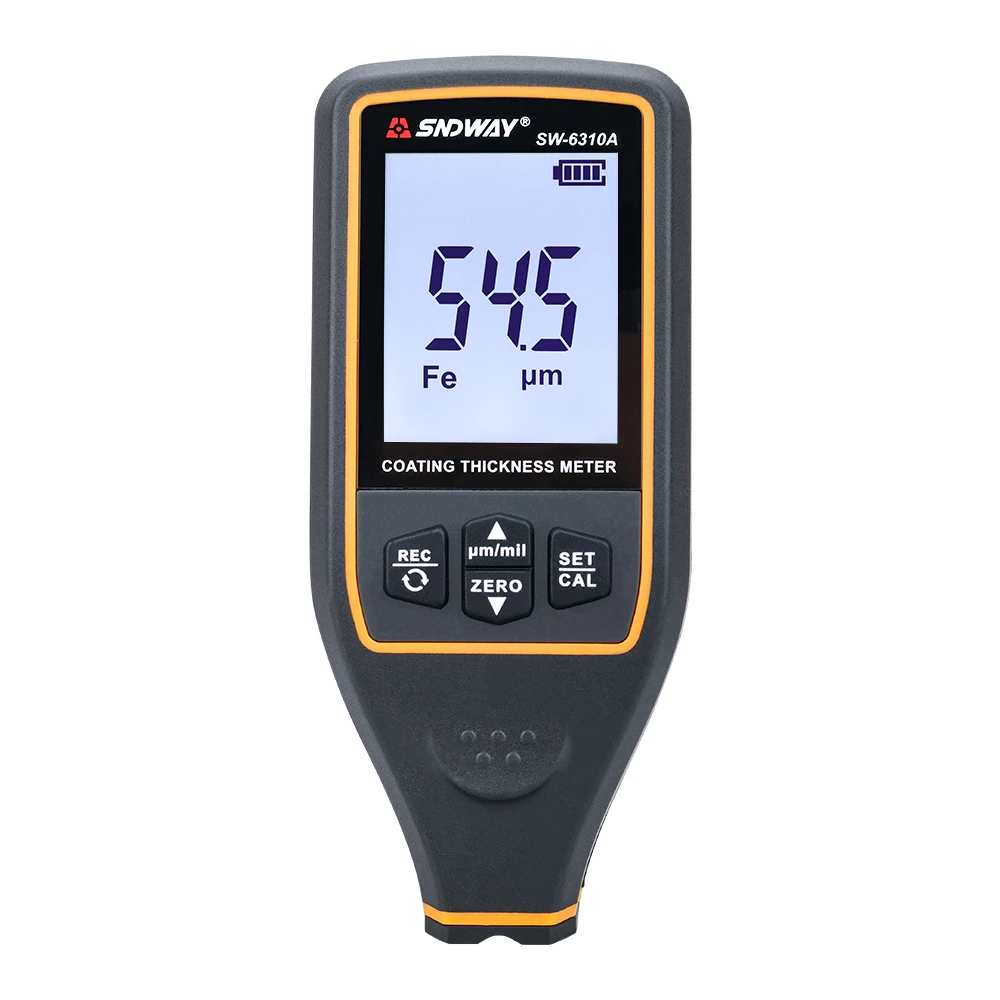
About the working principle of coating thickness gauge
With the advancement of technology, especially after the introduction of microcomputer technology in recent years, the thickness gauge using magnetic method and eddy current method has taken a big step in the direction of miniaturization, intelligence, multi-function, high precision and practicality step. The resolution of the measurement has reached 0.1 micron, and the accuracy can reach 1%, which has been greatly improved. It has a wide range of application, wide measurement range, convenient operation and low price. It is the most widely used thickness measuring instrument in industry and scientific research.
The non-destructive method neither damages the coating nor the substrate, the detection speed is fast, and a large amount of inspection work can be carried out economically. Measuring Principles and Instruments
1. Measuring principle of magnetic attraction force and thickness gauge * The size of the attraction force between the magnet (probe) and the magnetic conductive steel is proportional to the distance between them, that is, the thickness of the coating. Using this principle to make a thickness gauge, as long as the magnetic permeability difference between the coating and the substrate is large enough, it can be measured. Given that most industrial products are stamped and formed from structural steel and hot and cold rolled sheet, magnetic thickness gauges are the most widely used. The basic structure of the thickness gauge is composed of magnetic steel, relay spring, scale and self-stop mechanism. After the magnet and the object to be measured are attracted, the measuring spring is gradually elongated, and the pulling force is gradually increased. When the pulling force is just greater than the suction force, the thickness of the coating can be obtained by recording the pulling force at the moment of separation of the magnetic steel. Newer products can automate this logging process. Different models have different ranges and applicable occasions.
The instrument features simple operation, robustness, no power supply, no calibration prior to measurement, and low price, making it ideal for on-site quality control in workshops.
2. The principle of magnetic induction measurement When using the principle of magnetic induction, the thickness of the coating is measured by the magnitude of the magnetic flux flowing into the ferromagnetic substrate from the probe through the non-ferromagnetic coating. The magnitude of the corresponding magnetoresistance can also be measured to indicate the thickness of the coating. The thicker the coating, the higher the magnetic resistance and the lower the magnetic flux. The thickness gauge using the principle of magnetic induction can in principle have the thickness of the non-magnetic conductive coating on the magnetic conductive substrate. Generally, the magnetic permeability of the substrate is required to be above 500. If the cladding material is also magnetic, it requires a sufficiently large difference in permeability from the base material (eg nickel plating on steel). When the probe with soft core coil is placed on the sample to be tested, the instrument automatically outputs the test current or test signal. Early products used pointer gauges to measure the magnitude of the induced electromotive force, which amplified the signal and then indicated the thickness of the coating. In recent years, new technologies such as frequency stabilization, phase locking, and temperature compensation have been introduced in circuit design, and the measurement signal is modulated by magnetoresistance. The designed integrated circuit was also adopted and a microcomputer was introduced, which greatly improved the measurement accuracy and reproducibility (almost an order of magnitude). The resolution of modern magnetic induction thickness gauges can reach 0.1um, the allowable error can reach 1%, and the range can reach 10mm. The magnetic principle thickness gauge can be used to measure the paint layer on the steel surface, the protective layer of porcelain and enamel, the coating of plastic and rubber, various non-ferrous metal coatings including nickel-chromium, and various anti-corrosion layers. Coatings for the chemical and petroleum industries. .
3. Principle of Eddy Current Measurement
The high frequency AC signal creates an electromagnetic field in the probe coil, which creates eddy currents in the probe as the probe approaches the conductor. The closer the probe is to the conductive substrate, the greater the eddy currents and the greater the reflected impedance. This feedback effect characterizes the distance between the probe and the conductive substrate, that is, the thickness of the non-conductive coating on the conductive substrate. Because these probes are designed to measure coating thickness on non-ferromagnetic metal substrates, they are often referred to as non-magnetic probes. Non-magnetic probes use high-frequency materials for the coil core, such as platinum-nickel alloys or other new materials. Compared with the principle of magnetic induction, the main difference is that the probe is different, the signal frequency is different, and the size and proportion of the signal are different. Like the magnetic induction thickness gauge, the eddy current thickness gauge also achieves a high resolution of 0.1um, an allowable error of 1%, and a range of 10mm. The thickness gauge using the eddy current principle can in principle measure non-conductor coatings on all conductors, such as paints, plastic coatings and anodized films on the surfaces of aluminum products such as space shuttles, vehicles, household appliances, aluminum alloy doors and windows. The cladding material has a certain conductivity, which can also be measured by calibration, but the ratio of the conductivity of the two is required to be at least 3-5 times different (such as chrome plating on copper). Although a steel substrate is also a guide, for such tasks it is more suitable to use the magnetic principle for measurement.