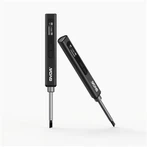
An electric soldering iron is required for welding and disassembling components.
Preparation work before welding and dismantling
1. To remove the oxide layer, it is necessary to easily dip the soldering iron head into the solder during welding. Before using an electric soldering iron, you can gently remove the oxide layer on the soldering iron head with a small knife or file. After scraping off the oxide layer, it will reveal a metallic luster.
2. Dip in flux
After removing the oxide layer on the soldering iron head, apply electricity to the soldering iron to heat it up. Then, dip the soldering iron head in rosin (available in electronic markets, do not go to markets), and you will see rosin vapor emitting from the soldering iron head.
The function of rosin is to prevent oxidation of the soldering iron tip at high temperatures and enhance the fluidity of the solder, making welding easier.
3. Hang tin. When the soldering iron tip is dipped in rosin to reach a sufficient temperature, rosin vapor will emerge from the soldering iron tip. Apply solder on the tip of the soldering iron tip and a layer of solder on the tip.
The advantage of hanging tin on the soldering iron head is to protect the soldering iron head from oxidation and make it easier to solder components. Once the soldering iron head "burns out", that is, if the temperature of the soldering iron head is too high, the solder on the soldering iron head will evaporate, and the soldering iron head will be burned black and oxidized, making it difficult to solder components. In this case, the oxide layer needs to be scraped off before hanging tin before use. So when the soldering iron is not used for a long time, the power should be unplugged to prevent the soldering iron from burning out.
4. Welding of components
When soldering components, first gently scrape off the oxide layer on the pins of the components to be soldered, then apply electricity to the soldering iron, heat it up, and dip it in rosin. When the temperature of the soldering iron head is sufficient, press the soldering iron head at a 45 ° angle on the copper foil next to the pins of the components to be soldered on the printed circuit board. Then, contact the soldering wire with the soldering iron head, and the soldering wire will melt into a liquid state that will flow around the pins of the components. At this time, move the soldering iron head away, and the soldering iron will cool down to weld the pins of the components to the copper foil of the printed circuit board.
When soldering components, the soldering iron should not touch the printed circuit board and components for too long to avoid damage. The soldering process should be completed within 1.5-4s, and the solder joints should be smooth and evenly distributed.
5. Disassembly of components
When disassembling components on a printed circuit board, use the tip of an electric soldering iron to contact the solder joint at the component pin. After the solder at the solder joint melts, pull out the component pin on the other side of the circuit board, and then solder the other pin using the same method. This method is convenient for disassembling components with less than 3 pins, but it is more difficult to disassemble components with more than 4 pins (such as integrated circuits).