Analysis of the working principle of the clamp ammeter from its internal structure
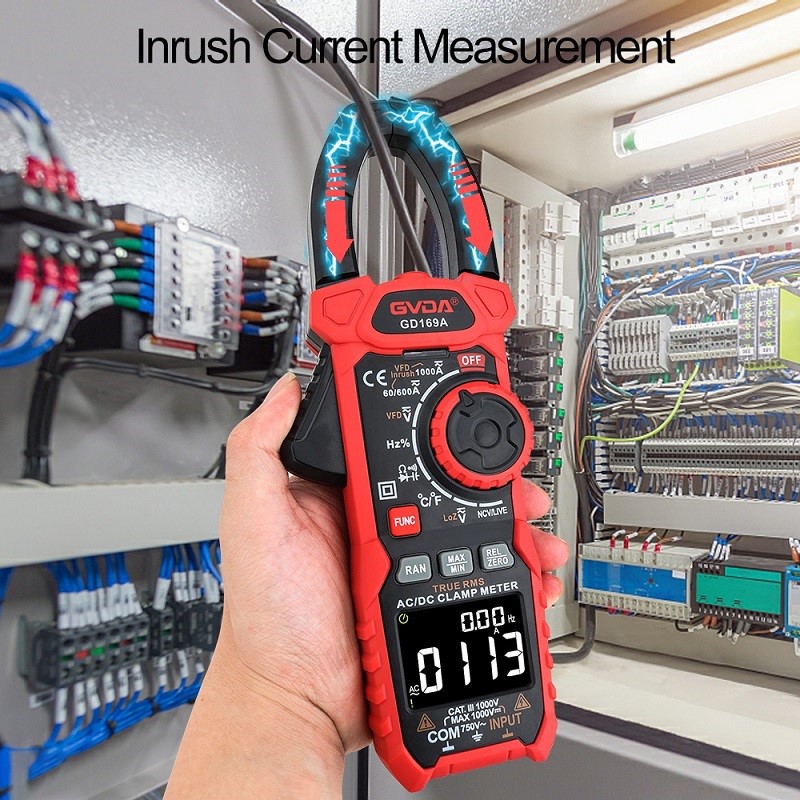
The clamp meter mainly consists of an electromagnetic ammeter and a through type current transformer. The secondary winding of the through type current transformer is wound around the iron core and connected to the AC ammeter, and its primary winding is the measured wire passing through the center of the transformer. When measuring current, press the wrench, open the clamp, and place the measured current carrying wire in the middle of the through type current transformer. When an alternating current passes through the measured wire, the magnetic flux of the alternating current induces a current in the secondary winding of the transformer. This current passes through the coil of the electromagnetic ammeter, causing the pointer to deflect and indicating the measured current value on the dial scale. The clamp ammeter must be connected in series with the circuit being tested.
In practical operation, it is obviously inconvenient to disconnect the line. The clamp type ammeter is a portable instrument that can directly measure the AC current of a circuit without disconnecting it. It is very convenient to use in electrical maintenance and has a wide range of applications.
The clamp knob is actually a range selection switch, and the function of the wrench is to open and close the movable part of the core of the through type transformer, so as to clamp the measured wire.
Precautions for using a clamp ammeter
(1) Before measuring with a clamp type meter, the ammeter should be zeroed first. Check the opening and closing of the jaws, requiring the movable part of the jaws to open and close freely, and the joint surfaces of the two jaws to be in close contact. When measuring, it is necessary to ensure that the jaws are tightly connected to reduce magnetic flux leakage and improve the measurement accuracy of the clamp type gauge
When measuring, the measured wire should be placed in the center position inside the clamp to reduce measurement errors. The range selection knob should be placed in an appropriate position to make the pointer exceed the middle scale during measurement, in order to reduce measurement errors. If the current of the measured circuit is not known in advance, the range selection knob can be set to high first, and then adjusted to the appropriate position according to the pointer deflection.
(3) When the current of the tested circuit is too small, even in the low range range, the deviation angle of the pointer is not large. To improve measurement accuracy, the tested current carrying wire can be wrapped around the iron core column of the clamp for a few turns before measurement. The actual measured current value can be obtained by dividing the pointer indication by the number of wires inserted into the clamp.
(4) When the clamp type meter is not in use, the range selection knob should be turned to the highest range gear to avoid accidentally damaging the instrument during the next use. If there are oil stains and debris on the jaws, they should be cleaned with solvent; If there are rust spots, they should be gently wiped off.