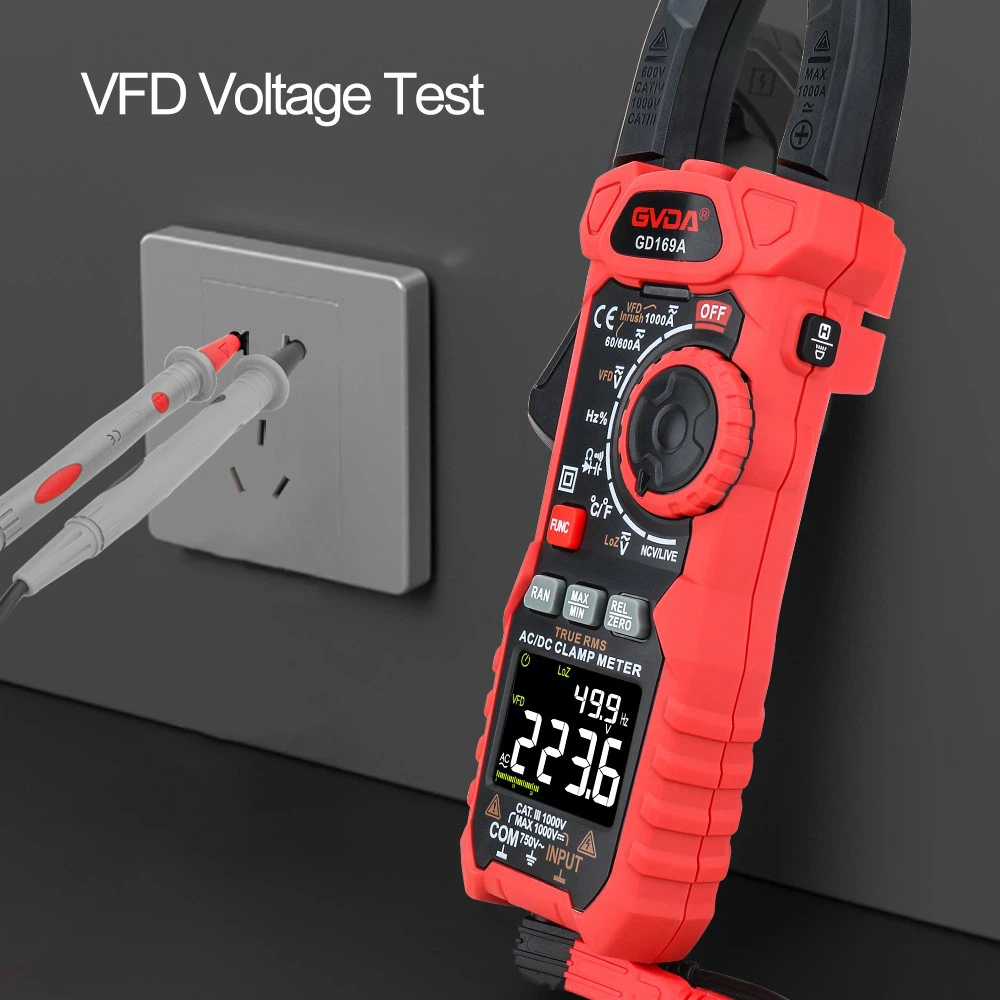
How to Use a Leakage Clamp Current Tester
The leakage current clamp meter mainly consists of impedance conversion, range conversion, AC/DC conversion, amplification, and indicator devices. Some also have overcurrent protection, sound and light alarm circuits, and test voltage regulation devices, and their indicator devices are divided into analog and digital types. According to UL standards in the United States, leakage current refers to the current that can be conducted from the accessible parts of household appliances, including capacitive coupling current. The leakage current includes two parts, one is the conducted current I1 through the insulation resistance; The other part is through the displacement current I2 of the distributed capacitor, which has a capacitance impedance of XC=1/2pfc inversely proportional to the power frequency. The distributed capacitor current increases with the increase of frequency, so the leakage current increases with the increase of power frequency. For example, when using a thyristor power supply, its harmonic components increase the leakage current.
If the assessment is on the insulation performance of a circuit or system, then this current should include not only all currents flowing into the earth (or conductive parts outside the circuit) through insulating materials, but also currents flowing into the earth through capacitive devices (distributed capacitors can be considered as capacitive devices) in the circuit or system. Longer wiring can result in larger distribution capacity and increase leakage current, which should be particularly noted in ungrounded systems.
Precautions for leakage clamp ammeter:
The principle of measuring leakage current is basically the same as measuring insulation resistance. Measuring insulation resistance is actually a type of leakage current, but it is expressed in the form of resistance. However, the formal measurement of leakage current applies AC voltage, so the component of leakage current includes capacitive current.
2. During the withstand voltage test, in order to protect the test equipment and test according to the specified technical specifications, it is also necessary to determine the maximum current value allowed to flow through the tested equipment (insulation material) under high electric field strength without damaging it. This current is usually referred to as leakage current, but this principle is only used in the specific situations mentioned above. Please pay attention to the differences.
3. Leakage current is actually the current that flows through the insulation part of an electrical circuit or equipment without any faults or applied voltage. Therefore, it is one of the important indicators to measure the insulation performance of electrical appliances and is the main performance indicator of products.
4. Leakage current tester is used to measure the leakage current generated by the working power supply (or other power sources) of electrical appliances through insulation or distributed parameter impedance, which is unrelated to work. Its input impedance simulates the impedance of the human body.