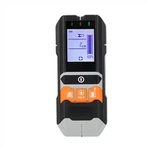
Analysis on Modern Application of Infrared Thermometer Technology
The temperature measurement principle of the infrared thermometer is to convert the infrared radiant energy emitted by the object into an electrical signal. The size of the infrared radiant energy corresponds to the temperature of the object itself. According to the size of the converted electrical signal, the temperature of the object can be determined. Infrared temperature measurement technology has been developed to scan and measure the temperature of the surface with thermal changes, determine its temperature distribution image, and quickly detect hidden temperature differences. This is the infrared thermal imager. Infrared thermal imaging cameras were first used in the military. In 2019, TI Corporation of the United States developed the world's first infrared scanning reconnaissance system. Later, infrared thermal imaging technology was successively used in aircraft, tanks, warships and other weapons in Western countries , as a thermal sighting system for reconnaissance targets, it greatly improves the ability to search and hit targets. The infrared thermal imaging camera produced by the Swedish AGA company is in a leading position in civilian technology.
The infrared thermometer is composed of optical system, photoelectric detector, signal amplifier, signal processing, display output and other parts. The optical system gathers the target infrared radiation energy in its field of view, and the size of the field of view is determined by the optical parts of the thermometer and its position. Infrared energy is focused on a photodetector and converted into a corresponding electrical signal. The signal passes through the amplifier and signal processing circuit, and is converted into the temperature value of the measured target after being corrected according to the algorithm of the internal treatment of the instrument and the emissivity of the target.
In nature, all objects with a temperature higher than absolute zero are constantly emitting infrared radiation energy to the surrounding space. The size of the infrared radiation energy of an object and its distribution according to the wavelength have a very close relationship with its surface temperature. Therefore, by measuring the infrared energy radiated by the object itself, its surface temperature can be accurately determined, which is the objective basis for infrared radiation temperature measurement.
A black body is an idealized radiator, which absorbs all wavelengths of radiation energy, has no reflection or transmission of energy, and has an emissivity of 1 on its surface. However, practical objects in nature are almost not black bodies. In order to clarify and obtain the distribution of infrared radiation, an appropriate model must be selected in theoretical research. This is the quantized oscillator model of body cavity radiation proposed by Planck, thus Derived the law of Planck's black body radiation, that is, the black body spectral radiance expressed by wavelength, which is the starting point of all infrared radiation theories, so it is called the law of black body radiation. The radiation amount of all actual objects depends not only on the radiation wavelength and the temperature of the object, but also on the type of material constituting the object, the preparation method, the thermal process, the surface state and the environmental conditions.
Infrared temperature measurement adopts a point-by-point analysis method, that is, the thermal radiation of a local area of the object is focused on a single detector, and the radiation power is converted into temperature through the emissivity of the known object. Due to the different detected objects, measurement ranges and usage occasions, the appearance design and internal structure of infrared thermometers are different, but the basic structure is generally similar, mainly including optical system, photodetector, signal amplifier and signal processing, display output and other parts. Infrared radiation emitted by a radiator. Entering the optical system, the infrared radiation is modulated into alternating radiation by the modulator, and converted into a corresponding electrical signal by the detector. The signal passes through the amplifier and signal processing circuit, and is converted into the temperature value of the measured target after being corrected according to the algorithm in the instrument and the target emissivity.
Three categories of infrared thermometers:
(1) Infrared thermometer for human use: Forehead-type infrared thermometer is a thermometer that uses the principle of infrared reception to measure the human body. When in use, you only need to conveniently align the detection window with the forehead, and you can quickly and accurately measure the body temperature.
(2) Industrial infrared thermometer: The industrial infrared thermometer measures the surface temperature of the object, and its optical sensor radiates, reflects and transmits energy, and then the energy is collected and focused by the probe, and then the information is converted into reading display by other circuits On the machine, the laser light equipped with this machine is more effective in aiming at the measured object and improving the measurement accuracy.
(3) Infrared thermometers for animal husbandry: Non-contact infrared thermometers for animals are based on the Planck principle, by accurately measuring the body surface temperature of specific parts of the animal body surface, and correcting the temperature difference between the body surface temperature and the actual temperature. Can accurately display the animal's individual body temperature.
Determining the wavelength range: The emissivity and surface properties of the target material determine the spectral response or wavelength of the pyrometer. For high reflectivity alloy materials, there is low or varying emissivity. In the high temperature area, the best wavelength for measuring metal materials is near infrared, and the wavelength of 0.18-1.0μm can be selected. Other temperature zones can choose 1.6μm, 2.2μm and 3.9μm wavelengths. Since some materials are transparent at a certain wavelength, infrared energy will penetrate these materials, and a special wavelength should be selected for this material. For example, the wavelengths of 10 μm, 2.2 μm and 3.9 μm are used for measuring the internal temperature of the glass (the glass to be tested must be very thick, otherwise it will pass through); the wavelength of 5.0 μm is used for measuring the internal temperature of the glass; ; Another example is to measure polyethylene plastic film with a wavelength of 3.43 μm, and polyester with a wavelength of 4.3 μm or 7.9 μm.
Determine the response time: The response time indicates the reaction speed of the infrared thermometer to the measured temperature change, which is defined as the time required to reach 95% of the energy of the final reading, which is related to the time constant of the photodetector, signal processing circuit and display system. The response time of the new infrared thermometer can reach 1ms. This is much faster than the contact temperature measurement method. If the moving speed of the target is very fast or when measuring a fast-heating target, a fast-response infrared thermometer should be selected, otherwise the sufficient signal response will not be achieved, and the measurement accuracy will be reduced. However, not all applications require a fast-response infrared thermometer. For static or target thermal processes where thermal inertia exists, the response time of the pyrometer can be relaxed. Therefore, the choice of the response time of the infrared thermometer should be adapted to the situation of the measured target.
The optical resolution is determined by the ratio D to S, which is the ratio of the distance D between the pyrometer to the target and the diameter S of the measurement spot. If the thermometer must be installed far away from the target due to environmental conditions, and a small target must be measured, a thermometer with high optical resolution should be selected. The higher the optical resolution, i.e. increasing the D:S ratio, the higher the cost of the pyrometer.
Determining the wavelength range: The emissivity and surface properties of the target material determine the spectral response or wavelength of the pyrometer. For high reflectivity alloy materials, there is low or varying emissivity. In the high temperature area, the best wavelength for measuring metal materials is near infrared, and the wavelength of 0.18-1.0μm can be selected. Other temperature zones can choose 1.6μm, 2.2μm and 3.9μm wavelengths. Since some materials are transparent at a certain wavelength, infrared energy will penetrate these materials, and a special wavelength should be selected for this material. For example, the wavelengths of 1.0 μm, 2.2 μm and 3.9 μm are used to measure the internal temperature of the glass (the glass to be tested must be very thick, otherwise it will pass through); the wavelength of 5.0 μm is used to measure the internal temperature of the glass; the wavelength of 8-14 μm is used for low measurement It is advisable; another example is to measure the wavelength of 3.43 μm for polyethylene plastic film, and the wavelength of 4.3 μm or 7.9 μm for polyester.
Determine the response time: The response time indicates the reaction speed of the infrared thermometer to the measured temperature change, which is defined as the time required to reach 95% of the energy of the final reading, which is related to the time constant of the photodetector, signal processing circuit and display system. The response time of Guangzhou Hongcheng Hong Kong CEM brand infrared thermometer can reach 1ms. This is much faster than contact temperature measurement methods. If the moving speed of the target is very fast or when measuring a fast-heating target, a fast-response infrared thermometer should be selected, otherwise the sufficient signal response will not be achieved, and the measurement accuracy will be reduced. However, not all applications require a fast-response infrared thermometer. For static or target thermal processes where thermal inertia exists, the response time of the pyrometer can be relaxed. Therefore, the choice of the response time of the infrared thermometer should be adapted to the situation of the measured target.
Signal processing function: Measuring discrete processes (such as parts production) is different from continuous processes, requiring infrared thermometers to have signal processing functions (such as peak hold, valley hold, average value). For example, when measuring the temperature of the glass on the conveyor belt, it is necessary to use the peak value to hold, and the output signal of its temperature is sent to the controller.
Consideration of environmental conditions: The environmental conditions of the thermometer have a great influence on the measurement results, which should be considered and properly resolved, otherwise it will affect the temperature measurement accuracy and even cause damage to the thermometer. When the ambient temperature is too high and there is dust, smoke and steam, you can choose the protective cover, water cooling, air cooling system, air blower and other accessories provided by the manufacturer. These accessories can effectively address environmental influences and protect the thermometer for accurate temperature measurement. When specifying accessories, standardize service should be requested as much as possible to reduce installation costs. When smoke, dust or other particles reduce the measurement energy signal, a two-color thermometer is the best choice. Under noise, electromagnetic field, vibration or inaccessible environmental conditions, or other harsh conditions, the fiber optic two-color thermometer is the best choice.
In applications with sealed or hazardous materials such as containers or vacuum chambers, the pyrometer views through a window. The material must be strong enough and pass through the operating wavelength range of the pyrometer being used. Also determine whether the operator also needs to observe through the window, so choose the appropriate installation location and window material to avoid mutual influence. In low-temperature measurement applications, Ge or Si materials are usually used as windows, which are opaque to visible light, and the human eye cannot observe the target through the window. If the operator needs to pass through the window target, an optical material that transmits both infrared radiation and visible light should be used. For example, an optical material that transmits both infrared radiation and visible light should be used as the window material, such as ZnSe or BaF2.
Simple operation and easy use: Infrared thermometers should be intuitive, easy to operate, and easy to be used by operators. Among them, portable infrared thermometers are small, light, and carried by people that integrate temperature measurement and display output. Temperature measuring instruments can display temperature and output various temperature information on the display panel, and some can be operated by remote control or computer software program.
In the case of harsh and complicated environmental conditions, a system with a separate temperature measuring head and display can be selected for easy installation and configuration. The signal output form matching the current control equipment can be selected. Calibration of the infrared radiation thermometer: the infrared thermometer must be calibrated so that it can correctly display the temperature of the measured target. If the temperature measurement of the thermometer used is out of tolerance during use, it needs to be returned to the manufacturer or the repair center for re-calibration.