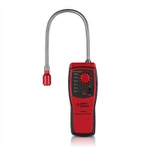
Applicable methods and classifications of gas detectors in air detection
The gas detector can detect various gases such as hydrogen sulfide, carbon monoxide, oxygen, sulfur dioxide, phosphine, ammonia, nitrogen dioxide, hydrogen cyanide, chlorine, chlorine dioxide, ozone and combustible gases, and is widely used in petrochemicals, coal , metallurgy, chemical industry, municipal gas, environmental monitoring and other places for on-site inspection. It can meet the measurement needs of special occasions; it can detect gas concentration or leak detection in tunnels, pipelines, tanks, confined spaces, etc.
Measuring this absorption spectrum can identify the type of gas; measuring the absorption intensity can determine the concentration of the measured gas. Infrared detectors have a wide range of use. They can not only analyze gas components, but also solution components. They have high sensitivity, rapid response, can provide online continuous indication, and can also form a regulating system. The detection part of the infrared gas detector commonly used in industry consists of two parallel optical systems with the same structure.
One is the measurement chamber and the other is the reference chamber. The two chambers open and close the light path simultaneously or alternately in a certain period through the light-cutting plate. After the measured gas is introduced into the measuring chamber, the light with the specific wavelength of the measured gas is absorbed, thereby reducing the light flux that passes through the optical path of the measuring chamber and enters the infrared receiving gas chamber. The higher the gas concentration, the less the light flux entering the infrared receiving gas chamber; while the light flux passing through the reference chamber is constant, the light flux entering the infrared receiving gas chamber is also constant. Therefore, the higher the concentration of the measured gas, the greater the difference in luminous flux passing through the measurement chamber and the reference chamber. This luminous flux difference is projected to the infrared receiving air chamber with a certain periodic vibration amplitude. The receiving gas chamber is divided into two halves with a metal film a few microns thick. The chamber is sealed with a relatively high concentration of the measured component gas. It can absorb all the incoming infrared rays within the absorption wavelength range, so that the pulsating light flux becomes The periodic changes in temperature can be converted into changes in pressure according to the gas equation, and then detected by a capacitive sensor. After amplification, the measured gas concentration is indicated. In addition to capacitive sensors, quantum infrared sensors that directly detect infrared rays can also be used. Infrared interference filters are used for wavelength selection and tunable lasers are used as light sources to form a new all-solid-state infrared gas detector. This kind of detector can complete the measurement of gas concentration using only one light source, one measurement chamber and one infrared sensor. In addition, if a filter disk equipped with multiple different wavelengths is used, the concentration of various gases in multi-component gases can be measured simultaneously.
Can be divided into desktop gas detectors and handheld gas detectors according to volume
According to the number of gases that can be detected, they can be divided into single gas detectors and multiple gas detectors
According to the principle of gas sensor, it can be divided into infrared to check whether the condenser is working normally. Usually the temperature is adjusted within 3 degrees Celsius, check the measuring chamber to see if it is dirty, and clean it in time.
Gas detector maintenance
1. Check the gas flow, usually 30/h. If the flow is too large or too small, it will have a greater impact on the results.
2. Replace the filter paper: stop the air pump and drain the filter tank.
3. Check whether there is any air leakage in the gas line system. Check whether the diaphragm of the sob pump is damaged, whether the sampling sealing ring is broken, whether the four-way valve and condensed steam are damaged, etc.
4. Clean the sampling probe and clear the sampling hole pipeline.
5. Check whether the condenser is working normally. Usually the temperature is adjusted within 3 degrees Celsius.
6. Check the measuring chamber to see if it is dirty and clean it in time.