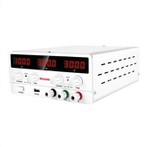
Application and characteristics of switching power supply
Switching power supplies mainly have the following characteristics:
1. Small size and light weight: Due to the lack of power frequency transformers, the volume and weight are only 20-30% of linear power supplies.
2. Low power consumption and high efficiency: Power transistors work in a switching state, so the power consumption on the transistor is low and the conversion efficiency is high, generally 60-70%, while linear power supplies only have 30-40%.
The working principle of a switching power supply is:
1. The AC power input is rectified and filtered into DC;
2. Control the switching transistor through high-frequency PWM (pulse width modulation) signal and apply the DC to the primary of the switching transformer;
3. The secondary of the switching transformer induces high-frequency voltage, which is rectified and filtered to supply the load;
4. The output part is fed back to the control circuit through a certain circuit to control the PWM duty cycle, in order to achieve stable output
When inputting AC power, it is generally necessary to pass through something like an eddy current loop to filter out interference on the power grid, as well as to filter out interference from the power source on the grid; When the power is the same, the higher the switching frequency, the smaller the volume of the switching transformer, but the higher the requirements for the switching tube; The secondary of a switching transformer can have multiple windings or one winding can have multiple taps to obtain the desired output; Generally, some protective circuits should be added, such as no-load and short circuit protection, otherwise it may burn out the switch power supply
Mainly used in industry and some household appliances, such as televisions, computers, etc
Four basic types of feedback circuits for single-chip switching power supplies
(1) Basic feedback circuit;
(2) Improved basic feedback circuit;
(3) Optocoupler feedback circuit with voltage regulator;
(4) Equipped with TL431 optocoupler feedback circuit.
The optocoupler feedback circuit equipped with TL431 is relatively complex, but has excellent voltage regulation performance. Here, TL431 adjustable precision parallel regulator is used instead of ordinary regulator to form an external error amplifier, and then UO is finely adjusted, which can achieve a voltage adjustment rate and load adjustment rate of ± 0.2%, comparable to linear regulator power supply. This feedback circuit is suitable for constructing precision switching power supplies.
Analysis of the main causes of damage to switch power modules:
The switch power module was not configured according to the actual DC load N+1, with the load current and charging current set at 10% of the rated capacity of the battery pack;
2 modules are often running at full load;
3. System current equalization causes a module to be running at full load;
4. The impact of high temperature in the computer room environment;
5. Failure to regularly clean the module filter (dirty filter can easily cause module stability and prevent timely release of accumulated temperature);
If there is too much dust in module 6 (due to the invasion and accumulation of dust causing potential faults), an air pump can be used to collect dust;
7 harmonic effects.