Application Scenarios, Advantages, and Uses of Clamp Meters
In the daily work of electricians, the clamp gauge is considered an electrical testing tool with a very high "appearance rate". It is the most commonly used instrument for detecting AC circuit current during operation, as there is no need to disconnect the measured circuit during measurement, making it very convenient to use. So, do you know how to choose the most suitable clamp watch for yourself?
The advantages and uses of clamp shaped watches
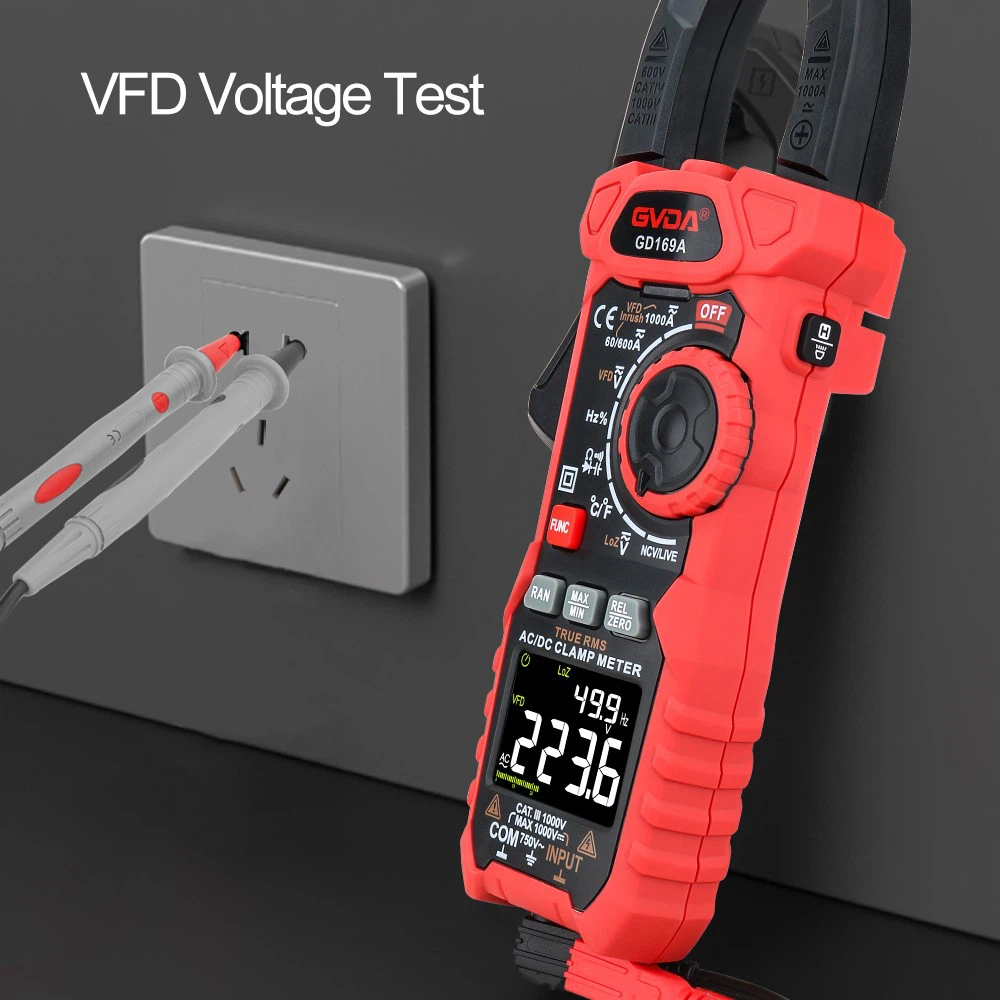
Most clamp meters have the first-line electrical diagnostic testing function of a digital multimeter (DMM), and can also be connected to circuits to measure voltage, current, frequency, capacitance, temperature, and resistance using test leads (as well as continuous testing circuits to check for faults or missing items). It also has a set of specialized spring-loaded jaws of various sizes that can be clamped around wires or busbars for non-invasive current measurement.
Clamp gauges typically measure common AC and DC currents. The clamp meter for measuring AC power is mainly used for public use, while the clamp meter for measuring DC power is mainly used for measuring industrial AC-DC conversion motors, as well as measuring battery DC power supply, and measuring DC power supply used in electric vehicle systems and solar array DC batteries. Although a multimeter can obtain contact amperage readings of up to 10A using test leads, a clamp meter can provide safer and more non-destructive current readings in the range of up to 3000A.
Some clamp gauges are single purpose pure ammeters that trade other functions for smaller jaws, higher resolution readings, higher sensitivity, and overall compact pocket design. Other clamp shaped watches will also have a "flexible clamp" flexible ring instead of jaws. The long and flexible ring can be manually wrapped around crowded cables in the cabinet, while using rigid clamps may be difficult to access.
There are also some high-quality clamp gauges that can provide better accuracy for more challenging work, and the "true equivalent RMS" (root mean square) clamp can measure more accurate equivalent DC RMS when the current waveform is sinusoidal or non sinusoidal. When wires are tied together, the induced coupling between wires due to current can cause stray (or "ghosting") voltages, resulting in inaccurate readings. Using the "LoZ" mode can eliminate errors. If VFDs are used in industrial sites, the low-pass filtering mode "Lo Pass" can be used to improve measurement accuracy. Some models of clamp gauges also use built-in pointing non-contact infrared thermometers to measure temperature (temperature gun). Some also use dual thermocouple inputs to calculate temperature differences (Δ - T), which is essential for HVAC/refrigeration engineering work.