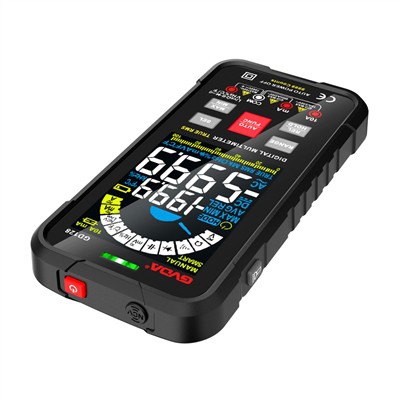
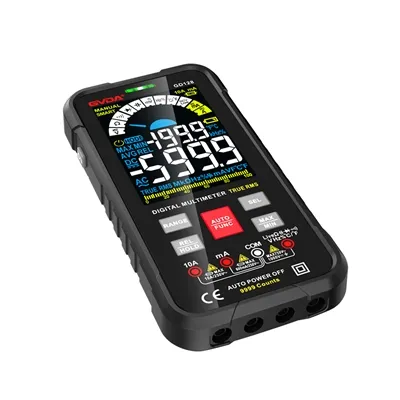
Basic Overview of Digital Multimeters
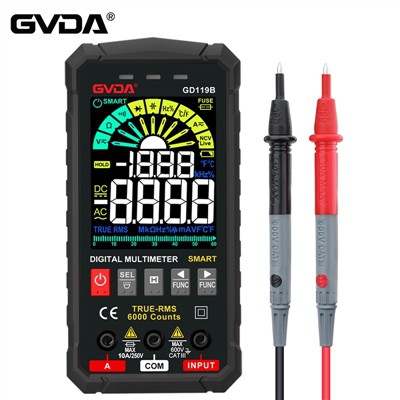
A digital multimeter (GMM) is an electronic instrument used in electrical measurement. It can have many special functions, but its main function is to measure voltage, resistance, and current. Digital multimeter, as a modern multi-purpose electronic measuring instrument, is mainly used in measurement fields such as physics, electrical, and electronics. Basic Overview of Digital Multimeters
Resolution, number of digits, words
The basic summary resolution of a digital multimeter refers to the quality of a meter's measurement results. By understanding the resolution of a table, you can determine whether you can see small changes in the measured signal. For example, if the resolution of a digital multimeter is 1mV within the 4V range, then when measuring a 1V signal, you can see a small change of 1mV (1/1000 volts).
If you want to measure a length less than 1/4 inch (or 1 millimeter), you will definitely not use a ruler with * small units in inches (or centimeters). If the temperature is 98.6 ° F, measuring with a thermometer marked only as an integer is useless. You need a thermometer with a resolution of 0.1 ° F. Humidity sensor probe, stainless steel electric heating tube PT100 sensor, cast aluminum heater, heating coil fluid solenoid valve
Digits and words are used to describe the resolution of a table. Numeric multimeters are classified based on the number of digits and words they can display.
A 3 and a half digit table can display three full digits from 0 to 9, and one half digit (only 1 or no display). A 3 and a half bit digital table can achieve a resolution of 1999 words. A four and a half digit number table can achieve a resolution of 19999 words. Basic Overview of Digital Multimeters
Using words to describe the resolution of a digital table is better than using bits to describe it. The resolution of a 3 and a half digit table has been increased to 3200 or 4000 words. Basic Overview of Digital Multimeters
The 3200 word digital table provides better resolution for certain measurements. For example, a 1999 word meter cannot display 0.1V when measuring voltages greater than 200V. The 3200 word digital meter can still display 0.1V when measuring a voltage of 320 volts. When the measured voltage is higher than 320V and a resolution of 0.1V is required, a more expensive 20000 word digital meter should be used.
accuracy
Accuracy refers to the maximum allowable error that occurs in a specific usage environment. In other words, accuracy is used to indicate
The closeness between the measured value of a digital multimeter and the actual value of the measured signal.
For a digital multimeter, accuracy is usually expressed as a percentage of the reading. For example, a reading accuracy of 1% means that when the digital multimeter displays 100.0V, the actual voltage may be between 99.0V and 101.0V.
Specific values may be added to the basic accuracy in the detailed instruction manual. Its meaning is to change the number of words to be added to the right end of the displayed *. In the previous example, the accuracy may be marked as ± (1%+2). Therefore, if the GMM reading is 100.0V, the actual voltage will be between 98.8V and 101.2V.
The accuracy of the analog meter is calculated based on the error of the full range, rather than the displayed reading. The typical accuracy of an analog meter is ± 2% or ± 3% of the full range. The typical basic accuracy of a digital multimeter is between ± (0.7%+1) and ± (0.1%+1) of the reading, or even higher.